UK Global Health Insurance Card (UK GHIC): Eligibility, Application & Healthcare Abroad Guide

The UK Global Health Insurance Card (UK GHIC) helps eligible UK travellers access medically necessary state-provided healthcare when visiting participating countries abroad. The card can be valuable if you need unexpected medical treatment during your trip, but it is important to understand what it covers, who can apply and how the healthcare system works in your destination.
This guide explains the UK Global Health Insurance Card, including eligibility requirements, the application process, card renewal and healthcare cover abroad. You will also learn what to do if your GHIC is lost or forgotten and why the card should be used alongside suitable travel insurance.
Applying through the official NHS service is free. However, the UK GHIC does not replace travel insurance and may not cover private treatment, medical repatriation or all travel-related emergencies. By checking your eligibility and preparing before you travel, you can use your UK GHIC with greater confidence and understand your healthcare options abroad. Visit our homepage fo more information Click Here
What Is a UK Global Health Insurance Card?
The UK Global Health Insurance Card (GHIC) allows eligible people to receive medically necessary healthcare from the state healthcare system when visiting countries included in the scheme.
Treatment is provided under the same conditions that apply to people who live in the country you are visiting. This means some treatment may be free, while certain services may involve a patient charge or co-payment if local residents are also required to pay.
For many people, the UK GHIC replaced the previous European Health Insurance Card following the UK’s departure from the European Union. However, people who have rights under the Withdrawal Agreement may still be able to apply for a UK EHIC instead.
UK GHIC at a Glance
Important: Be careful when using websites that charge a fee to process a UK GHIC application. The official NHS service does not charge for the application.
How to Apply for a UK GHIC

If you are searching for terms such as apply EU health card, make sure you use the official NHS route rather than a commercial application service.
The online application is completed through the NHS Overseas Healthcare Services system.
1. Confirm Your Eligibility
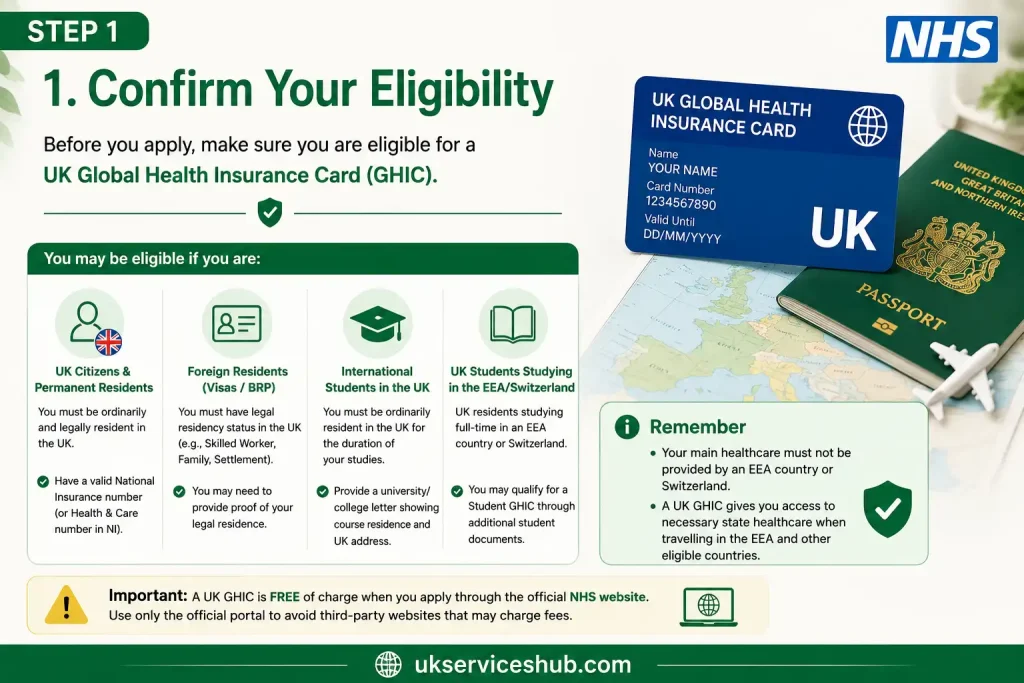
Before beginning the application, check whether you meet the relevant requirements.
Consider the following questions:
Checking these points before you start may help prevent delays.
2. Gather the Required Information

It is useful to have your personal details ready before opening the application.
You may need information such as:
Applicants aged 16 or over will generally need to provide a National Insurance number when applying online. If you do not have one, the NHS provides alternative contact arrangements for GHIC applications.
3. Apply Through the Official NHS Service

Use the official NHS application page to begin the process.
Avoid commercial websites that charge for submitting an application. Paying a third party does not provide you with additional NHS entitlement.
4. Check the Main Applicant’s Details
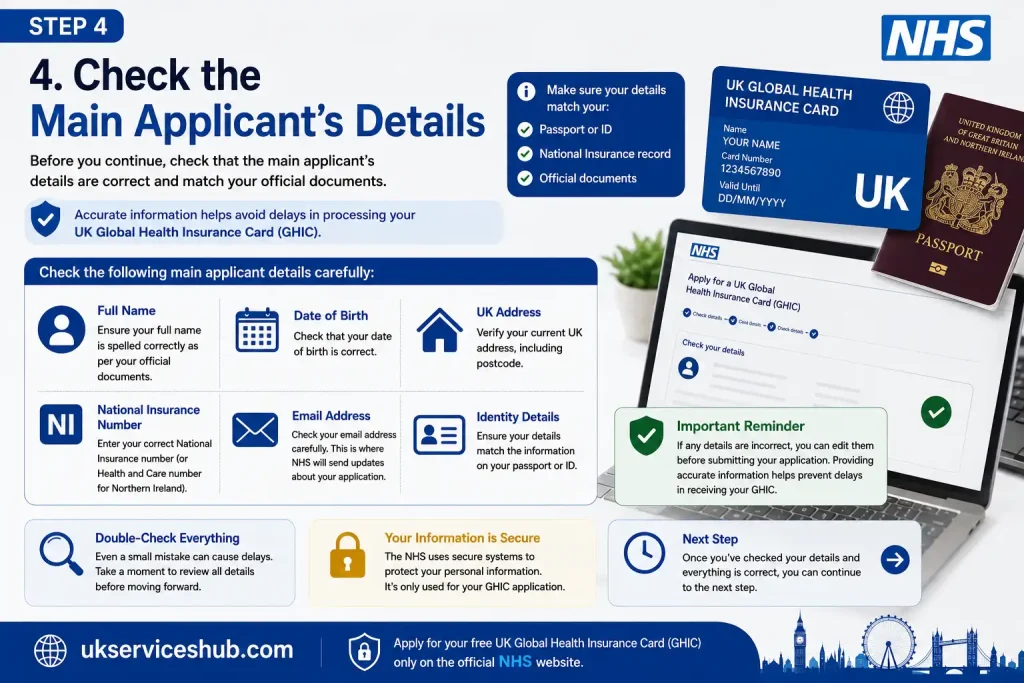
Enter your information carefully and review it before continuing.
Pay particular attention to:
Incorrect information may delay the application or result in a request for further evidence.
5. Include Eligible Family Members

Every eligible person needs a separate UK GHIC, even if the application is completed as part of a family application.
Depending on the circumstances, eligible family members may include a spouse, civil partner or children. Each person’s eligibility must still be assessed individually, and their information should be entered accurately because the NHS issues separate cards rather than a single family card.
6. Check Everything Before Submitting

Before you submit the application, review all the information carefully.
Make sure that:
Once the application is submitted, it will be processed through the relevant NHS Overseas Healthcare Services system.
Who Can Get a UK GHIC?
Eligibility depends largely on your legal residence and your healthcare arrangements. In general, you may qualify if you are ordinarily and legally resident in the UK and your healthcare is not already covered by an EEA country or Switzerland.
Certain groups, including people who live outside the UK, students and some family members, may need to follow different application routes.
UK Citizens and Permanent Residents
Many people who live in the UK can apply for a UK GHIC if they meet the relevant residency requirements.
During the online application, you may be asked to provide details such as:
The NHS may check your information to confirm your eligibility. If your entitlement cannot be verified automatically, you may be asked to provide additional evidence or documents.
Foreign Nationals Legally Living in the UK
British citizenship is not always required to qualify for a UK GHIC. People who are legally resident in the UK may be eligible depending on their residency position and whether another country is responsible for their healthcare.
In some cases, the NHS may request evidence of your UK residence or immigration status. Depending on your circumstances, this could include documents relating to your legal status or proof of your UK address.
However, having a visa does not automatically mean you are entitled to a UK GHIC. Eligibility is assessed according to your individual circumstances and healthcare arrangements.
Students and People Studying Abroad
Students may need to provide additional information when applying for healthcare cover for a period of study overseas.
If you normally live in the UK but are studying in the EEA or Switzerland, you may need a letter from your university or college confirming:
The appropriate card may depend on when your studies began and your personal circumstances. Some students may be eligible for a UK Student EHIC, while others may need a UK Student GHIC.
When You May Not Qualify
A UK GHIC is not automatically available to everyone with a connection to the UK.
For example, you may not qualify under the standard UK residency rules if another country in the EU, Switzerland, Norway, Iceland or Liechtenstein is responsible for your healthcare. Because eligibility can vary, it is important to check the official guidance for your specific situation before applying.
What Happens After You Submit Your Application?
After you submit a UK GHIC application, the NHS says it will normally send an email within 24 hours confirming whether your application has been approved or whether it needs further information. If you do not receive the email, check your junk or spam folder.
Once approved, your card should usually be delivered by post within 15 working days. For this reason, it is best to apply well before your travel date rather than waiting until just before you leave.
If you need medically necessary treatment abroad before your approved card arrives, you may be able to obtain temporary cover through a Provisional Replacement Certificate (PRC).
Renewing Your UK Global Health Insurance Card Online
Many travellers search for uk global health insurance card renewal online. The key point is that you do not need to wait until your existing card has expired. If you are eligible, you can apply for a replacement up to nine months before the expiry date.
A UK GHIC can be valid for up to five years. If you have an unexpired UK EHIC, you can continue using it until it reaches its expiry date. Once it expires, you can apply for the appropriate replacement card through the official NHS service.
For any uk global health insurance card renewal online application, use the official NHS route. There is no need to pay a third-party company to submit an application on your behalf.
When Is the Best Time to Renew Your GHIC?
Applying before your card expires can give you time to deal with any eligibility checks or requests for further information.
A sensible approach is to:
For instance, a change to your place of residence or the country responsible for your healthcare could affect your entitlement.
Countries Where You Can Use a UK GHIC
A UK Global Health Insurance Card can be used in the European Economic Area (EEA) and certain other locations covered by reciprocal healthcare arrangements.
According to the NHS, a UK GHIC can be used when visiting:
Different eligibility rules apply to Switzerland. Depending on their nationality and circumstances, certain British nationals, Swiss nationals, EU citizens, refugees, stateless people and qualifying family members may be able to use a UK GHIC there.
Healthcare arrangements can change, so it is important to check the latest official guidance before travelling. The UK government also recommends checking country-specific healthcare information and travel advice before you leave the UK.
Why a UK GHIC Is Not Enough on Its Own
A UK GHIC can provide valuable healthcare support while you are abroad, but it is not a complete travel protection policy.
The card does not replace private travel insurance and will not normally cover:
For better protection, travel with an eligible UK GHIC and suitable private travel and medical insurance.
Key takeaway: Your GHIC can help you access medically necessary state healthcare in participating countries, but travel insurance provides protection for costs and situations that the health card does not cover.
A UK Global Health Insurance Card (UK GHIC) can help eligible travellers access necessary healthcare while visiting participating countries, but it does not provide the same level of protection as private medical or travel insurance. Its purpose is to help you access state-provided healthcare that becomes medically necessary during your stay, subject to the healthcare rules of the country you are visiting.
That distinction matters. Your health card may reduce or cover some of the costs of necessary treatment, but it is not designed to pay for every medical expense or every problem that could arise during a trip abroad.
What Healthcare Can a UK GHIC Cover?
The UK Global Health Insurance Card can give you access to medically necessary treatment through the state healthcare system of a country covered by the scheme.
Depending on your circumstances and where you are travelling, this may include:
The care available to you will depend on your medical needs and the healthcare arrangements that apply in the country you are visiting.
Key point: A UK GHIC does not guarantee that all healthcare will be free. You are usually treated on the same basis as a resident of the country you are visiting. If local residents are required to pay a contribution towards treatment, you may also need to pay. NHS UK GHIC guidance
What Does a UK GHIC Cover and What Does It Not Cover?
The following comparison shows where a UK Global Health Insurance Card can help and where additional travel insurance may be needed:
| Healthcare or travel situation | UK GHIC position |
|---|---|
| Emergency state-provided treatment | Generally covered when medically necessary |
| Treatment for pre-existing conditions | May be covered when medically necessary |
| Accident and emergency care | May be covered through the local state healthcare system |
| Routine maternity care | May be covered when medically necessary |
| Private healthcare | Not covered |
| Medical repatriation to the UK | Not covered |
| Private rescue services | Not covered |
| Lost luggage | Not covered |
| Cancelled travel | Not covered |
| Travel delays | Not covered |
The most important point is that a UK GHIC is not comprehensive travel protection.
For example, if you become seriously ill abroad, your GHIC may help you access medically necessary treatment through the local public healthcare system. However, it would not normally pay for a medical flight or other arrangements required to bring you back to the UK.
This is one of the main reasons travellers are advised not to treat a GHIC as a replacement for suitable travel insurance.
Do You Still Need Travel Insurance If You Have a UK GHIC?
Yes.
The safest approach is to travel with your UK Global Health Insurance Card and appropriate private travel insurance.
A GHIC can help with the cost of medically necessary state-provided healthcare, but private travel insurance can protect you against expenses and situations that fall outside the card’s cover.
Depending on the policy, travel insurance may provide cover for:
Before travelling, read your policy documents carefully. Cheaper policies can contain exclusions or limits that may leave you responsible for significant costs.
How to Use Your UK GHIC at a Hospital or Healthcare Provider
If you need treatment abroad, present your UK Global Health Insurance Card at a suitable state healthcare provider.
However, not every doctor, hospital or clinic operates within the public healthcare system, and private facilities may not accept the card.
Where possible, take the following steps before receiving treatment:
Do not assume that a facility is state-provided simply because it is described as a hospital or clinic. In many countries, public and private healthcare providers operate alongside each other.
What to Do If You Need Emergency Medical Treatment Abroad
If you have a serious accident or medical emergency while travelling, getting the right medical help should always come first.
Where your UK Global Health Insurance Card (UK GHIC) applies, show it to the healthcare provider as soon as it is practical to do so. If your condition prevents you from presenting the card, a family member, friend or another representative may be able to provide your details later.
You should also contact your travel insurer when you can, particularly if:
A UK GHIC can help you access necessary state-provided healthcare, but it does not deal with every financial or practical issue connected with a medical emergency.
What Is a Provisional Replacement Certificate?
A Provisional Replacement Certificate (PRC) is a temporary document that can confirm your entitlement to healthcare if you need medically necessary treatment abroad but do not have your UK GHIC with you.
You may need a PRC in situations such as:
A PRC is intended for situations where you genuinely require treatment and need proof of your healthcare entitlement.
The relevant NHS Overseas Healthcare Services team can assess your circumstances and issue a certificate where appropriate.
How to Apply for a PRC
If you need a Provisional Replacement Certificate while abroad, contact the relevant NHS Overseas Healthcare Services team as soon as possible.
You may be asked to provide information such as:
The official NHS guidance includes contact information for people who need treatment but do not have their GHIC or EHIC available.
A PRC should not be confused with a replacement plastic card. It is a temporary document that confirms your entitlement in an urgent healthcare situation.
What If Your UK GHIC Is Lost or Stolen?
Losing your card before or during a trip can be frustrating, but it does not necessarily mean that you have lost your entitlement to healthcare cover.
If you are abroad and need medically necessary treatment without the physical card, you may be able to obtain a PRC.
If you are still in the UK, check the official NHS application service for the appropriate replacement process. Avoid entering your personal details on a third-party website that charges for a service you can access through the official route.
When arranging a replacement, check that the NHS has accurate details for you and any affected family members.
Can You Apply for an EU Health Card If You Live in the UK?
The search term apply EU health card can be confusing because the right card depends on your nationality, place of residence and individual circumstances.
For many people who live in the UK, the relevant healthcare card is now the UK Global Health Insurance Card rather than the previous European Health Insurance Card.
However, some people may still qualify for a UK EHIC. This can include certain people protected by arrangements introduced following the UK’s departure from the EU, including some individuals who began living, working or studying in relevant circumstances before the end of 2020.
If you are searching for information on how to apply EU health card cover, do not choose a card simply because of its name. Check the official NHS eligibility guidance to identify the card that applies to your circumstances.
Preparing to Travel With Your UK GHIC
A little preparation before leaving the UK can help prevent unnecessary problems if you need healthcare during your trip.
Check Your Card’s Expiry Date
Check the date shown on your card before travelling. A standard UK GHIC can be valid for up to five years, but you should always confirm the expiry date on your own card.
If your card is approaching its expiry date, you may be able to begin the uk global health insurance card renewal online process through the official NHS service up to nine months before it expires.
Confirm Your Destination Is Covered
Healthcare agreements and country-specific arrangements can vary. Before travelling, confirm that your destination is covered by the UK GHIC and check the latest official information.
Do not rely solely on old travel forums or outdated articles when planning your healthcare cover abroad.
Arrange Suitable Travel Insurance
A valid health card does not remove the need for travel insurance.
Make sure your policy provides suitable medical protection and consider whether it covers:
Take Essential Information With You
Consider travelling with:
Digital copies of important documents can also be useful. However, a digital image of your card may not always replace the physical UK GHIC when you need to access healthcare.
Common UK GHIC Mistakes to Avoid
Mistake 1: Paying an Unofficial Website to Apply
The official NHS application is free.
Paying a third-party website to process an application does not provide you with a better card or additional NHS healthcare rights. Always begin with the official NHS service.
Mistake 2: Expecting the Card to Cover Private Healthcare
The UK GHIC is intended to help eligible people access state-provided healthcare.
If you choose treatment at a private hospital or clinic, the card may not provide any cover.
Mistake 3: Assuming All Medical Costs Will Be Free
A UK GHIC does not guarantee completely free treatment. Local residents may need to contribute towards healthcare costs, prescriptions or other services, and the same rules may apply to you.
Mistake 4: Applying Too Close to Your Travel Date
Applications can involve eligibility checks or requests for further information, and the physical card is delivered by post.
Applying early gives you more time to deal with any issues before you travel.
Mistake 5: Treating a GHIC as a Full Travel Insurance Policy
This is one of the most significant misunderstandings.
The UK Global Health Insurance Card can help you access medically necessary state healthcare, but it does not provide complete financial protection against every medical or travel emergency.
Quick Checklist Before Leaving the UK
Taking a few minutes to prepare before travelling can make a significant difference if you unexpectedly need medical care abroad.
Frequently Asked Questions About the UK GHIC and Healthcare
Conclusion
The UK Global Health Insurance Card (UK GHIC) helps eligible travellers access medically necessary state healthcare when visiting participating countries. Before travelling, check your eligibility, make sure your card is valid and apply only through the official NHS service, where the application is free.
Remember, the UK GHIC does not replace travel insurance. It may not cover private treatment, medical repatriation or all travel-related emergencies. Combining your GHIC with suitable travel insurance can help you travel abroad with greater confidence and better protection.