
EPC Register UK 2026: Check Your Energy Certificate Online
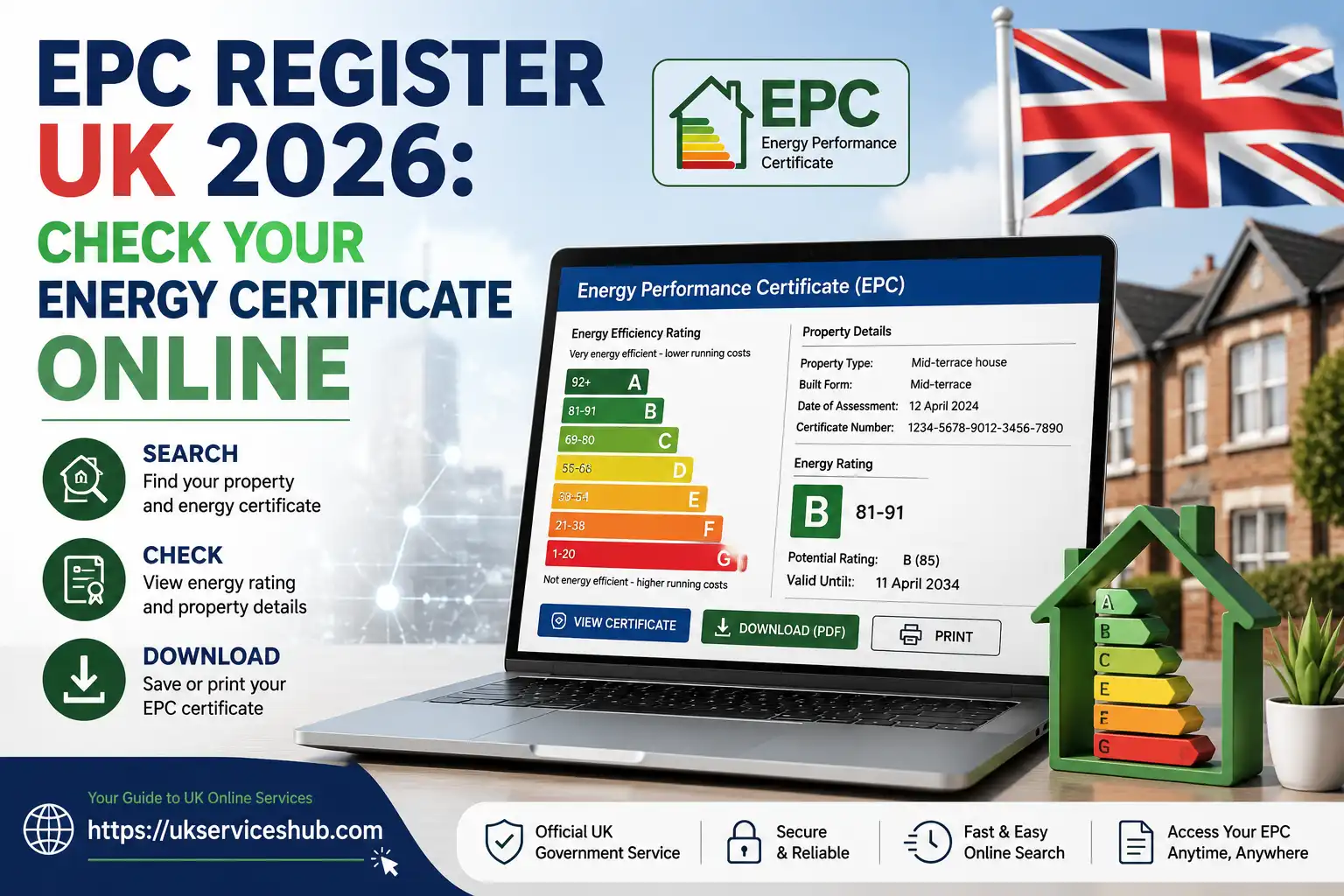
Searching the EPC Register UK can be useful when you are buying a home, renting a property, preparing to sell, or simply checking how energy efficient a building is. The official GOV.UK service allows you to look for an existing Energy Performance Certificate (EPC) covering properties in England, Wales and Northern Ireland.
For most searches, an epc register check online can be completed within a few minutes. You can look up a certificate using property details such as the postcode, street name and town, or the certificate number. If a valid EPC cannot be found, the property may require a new assessment.
Whether you are a tenant comparing rental homes, a buyer researching a property or a landlord getting ready to let a building, checking the official register gives you a reliable starting point for understanding its energy performance.Go to main site.Click Here.
Understanding the EPC Register
An Energy Performance Certificate provides an indication of how efficiently a building uses energy. For domestic properties, the rating runs from A to G: A is the highest efficiency band, while G is the lowest.
A certificate can also provide information about energy performance, typical energy costs and recommended improvements that may help make the property more efficient. An EPC is normally valid for 10 years, although a newer certificate can replace an earlier one for the same property.
The official GOV.UK search service can contain records for several types of buildings and energy certificates, including:
Using the government service is therefore preferable when you want to locate an official energy certificate rather than relying on an independent EPC website.
Can You Check the EPC Register for Free?
Yes. The GOV.UK service allows you to search for an existing energy certificate online, and government guidance for selling a home states that you can check whether a property has a valid EPC and download the certificate without paying for the search.
This makes an epc register check online free a sensible first step before arranging another assessment.
There is an important distinction, however. Searching for an existing EPC does not mean that a new certificate is free. If no valid certificate exists, or the previous EPC has expired, a new assessment must be carried out by an accredited assessor. The price of that assessment can vary according to the property and assessor.
How to Carry Out an EPC Register Check Online

You generally do not need to create an account simply to search for an existing certificate. The process can be completed through the official GOV.UK service.
1. Go to the Government EPC Search

Begin with the official GOV.UK service:
Choose Start now to enter the certificate search system. The service covers properties in England, Wales and Northern Ireland; Scotland has a separate EPC service.
Useful tip: Make sure you are using the genuine GOV.UK website when looking for official energy information. Search results may also display private businesses offering EPC assessments or related services.
2. Choose the Relevant Property Type
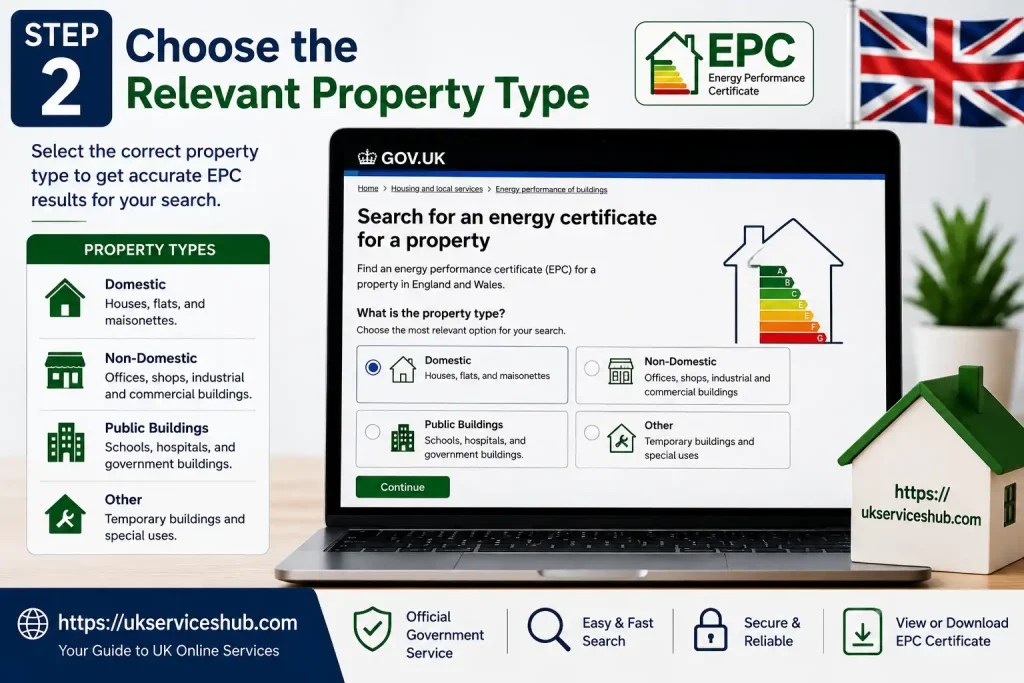
Follow the options shown by the service and select the type of property you need to search for.
For a normal house, flat or other residential building, you will usually be looking for a domestic EPC. If you are researching an office, commercial building or another non-domestic property, select the appropriate option available within the service.
3. Enter the Property Information
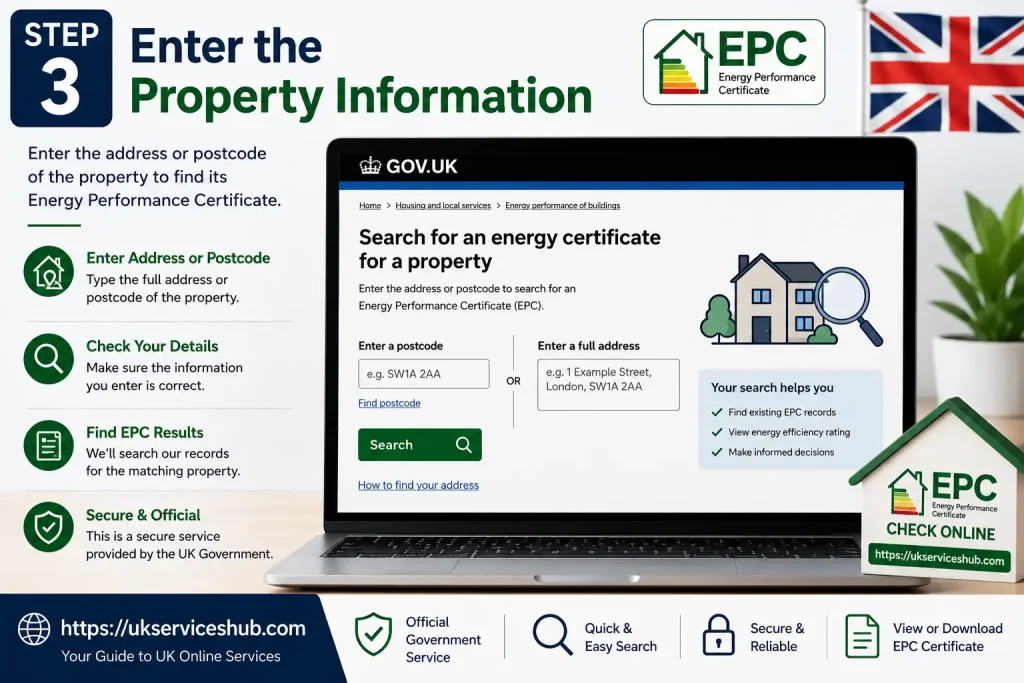
The EPC service provides several ways to locate a certificate. Depending on the search, you can use:
Using a postcode is often the easiest method when you know the property’s full location.
A certificate number can be particularly useful if a landlord, seller or estate agent has already provided it. It can help you locate a specific record where several properties have similar addresses.
4. Confirm the Correct Address
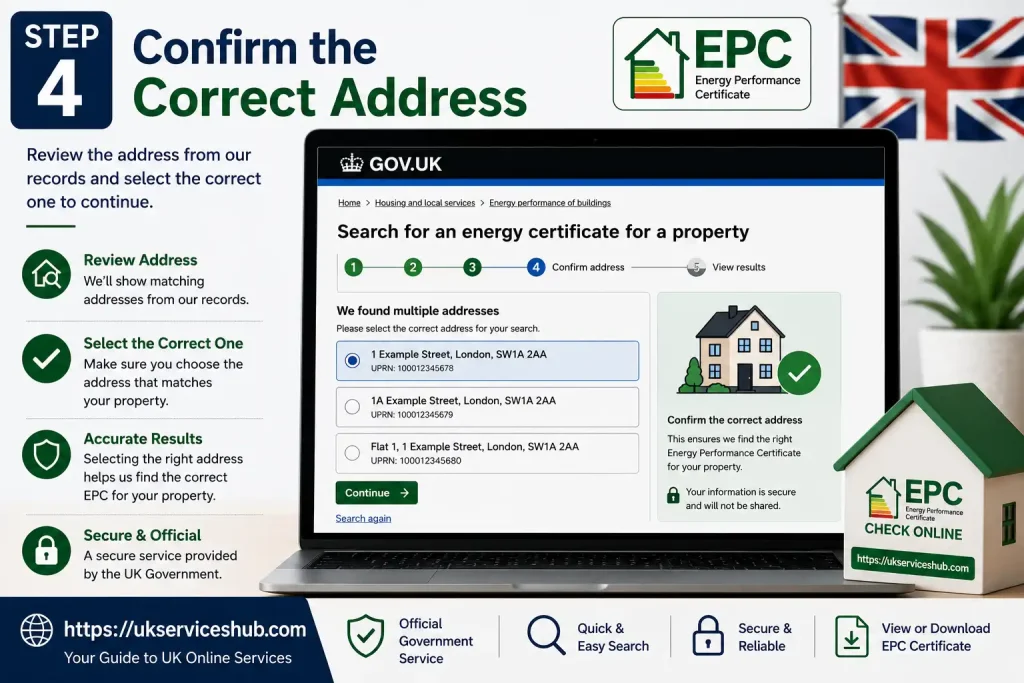
Review the search results before opening a certificate. If the system returns several properties, select the address that corresponds exactly to the building you are researching.
Check details such as the house number and street rather than selecting the first similar-looking result. This is especially worthwhile when you are checking a property before agreeing to a tenancy or proceeding with a purchase.
5. Review the Certificate Information
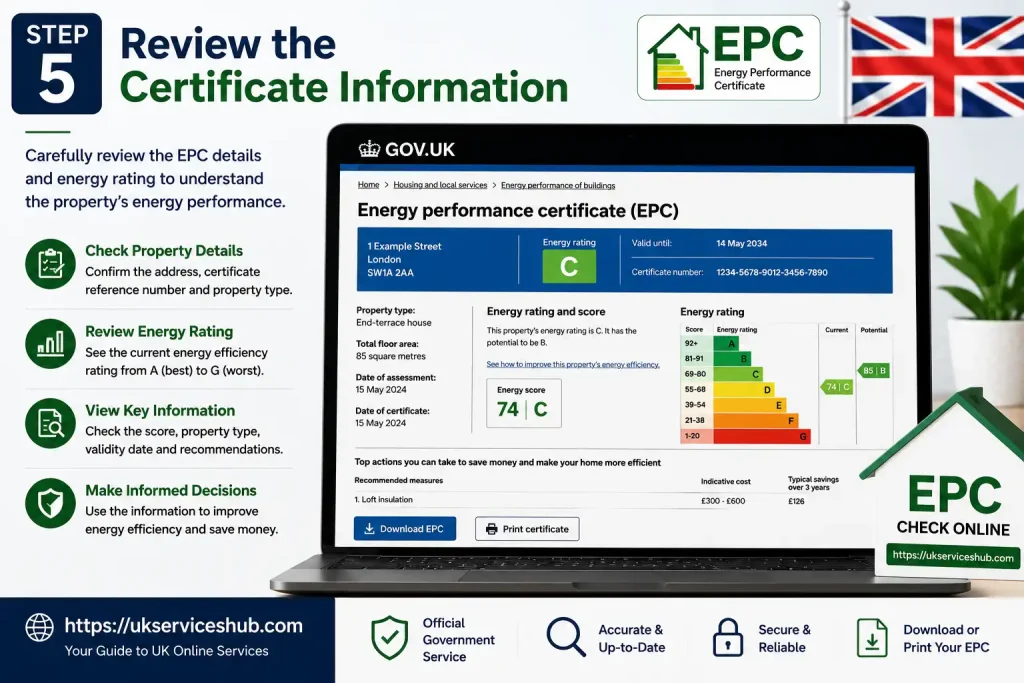
After selecting the correct property, you can inspect the information associated with the available EPC.
Depending on the certificate record, this may include:
The purpose of this information is to help prospective buyers and tenants understand the property’s energy performance before making decisions about it.
6. View or Save the EPC
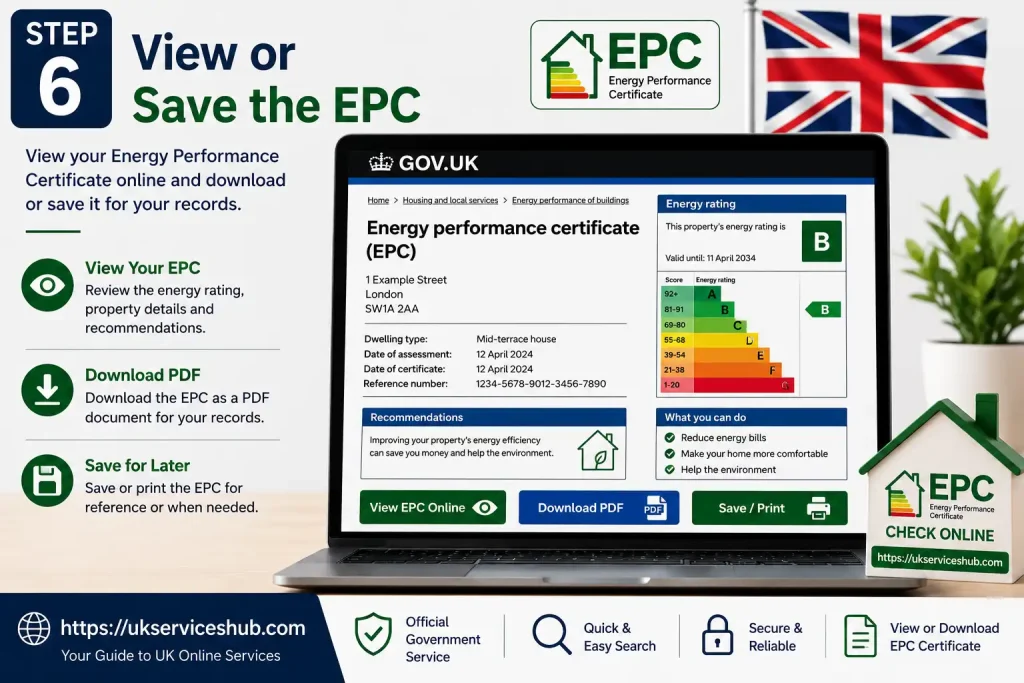
When an EPC is available, you can view the certificate details online and use the relevant print or download function to retain a copy.
Keeping the certificate can be useful when comparing properties, reviewing tenancy paperwork, researching a purchase or discussing energy improvements with a property professional.
EPC Register Search Options
| Search method | When it is useful | Information required |
|---|---|---|
| Postcode | General property searches | Property postcode |
| Street name and town | When you do not have the postcode | Street name and town |
| Certificate number | Locating a particular EPC | Certificate/report number |
The GOV.UK service supports these search methods for locating available energy certificate records.
How to Read an EPC Rating
Locating the certificate is only part of the process. You also need to understand what the rating means.
Domestic EPCs use an A-to-G scale. A higher band generally indicates better energy efficiency and lower expected energy use than a lower band. The certificate can also provide recommendations for improvements that could raise the property’s energy performance.
The domestic EPC bands are generally presented as follows:
| EPC band | Score | General indication |
|---|---|---|
| A | 92+ | Very high efficiency |
| B | 81–91 | High efficiency |
| C | 69–80 | Good efficiency |
| D | 55–68 | Average efficiency |
| E | 39–54 | Lower efficiency |
| F | 21–38 | Poor efficiency |
| G | 1–20 | Lowest efficiency |
These score ranges are also reported in EPC data published by the Office for National Statistics for England and Wales.
What Does an EPC A Rating Indicate?
An A-rated property sits at the highest end of the domestic EPC scale and generally demonstrates strong energy performance.
Features such as effective insulation, efficient heating equipment, newer construction and renewable technologies can contribute to a higher rating. The exact factors behind an individual score will depend on the property and its assessment.
Is an EPC C Rating Good?
A C rating indicates a reasonably efficient property and is often of interest to buyers and tenants who want to compare energy performance between homes.
Even so, an EPC rating should not be treated as a precise prediction of your future energy bills. Actual costs depend on factors including energy prices, how the property is occupied, household behaviour and how much heating and energy are used.
What Does an EPC F or G Rating Mean?
F and G are the lowest domestic EPC bands. A property within either band may have considerable scope for improving its energy efficiency.
The recommendations included on the certificate can help identify potential measures, which may include insulation upgrades or improvements to the heating system. The suggested work will depend on the individual property and its EPC assessment.
What Can You Find on an EPC?
An EPC provides more than a simple A–G efficiency grade. It is designed to give property owners, buyers and tenants useful information about a building’s current energy performance and possible improvements.
When completing an epc register check online gov uk, it is worth reviewing the full certificate rather than focusing only on the headline rating.
Current Energy Performance
The current rating provides a quick overview of the property’s existing energy efficiency. It gives you a useful starting point when comparing one property with another.
Potential Energy Performance
An EPC may also show a potential rating based on the improvements recommended in the certificate. This gives homeowners an idea of how the property’s energy performance could change if suggested measures were introduced.
Typical Energy Costs
The certificate can include estimated energy-related costs. These figures are intended as an indication and should not be treated as a prediction of the actual amount you will personally pay, as real energy use varies between households.
Recommended Improvements
The recommendations section identifies measures that could improve the building’s energy efficiency. This can be particularly useful for buyers or homeowners who want to understand whether a property may benefit from upgrades.
Certificate Information and Dates
Pay attention to the certificate date when reviewing an EPC. A standard certificate is normally valid for 10 years, although a newer EPC can replace an older certificate before the original validity period ends.
When Is an EPC Required?
An Energy Performance Certificate is generally required when a building is:
If a property is being marketed for sale or rent and there is no valid EPC, the seller or landlord must arrange for one to be commissioned. GOV.UK guidance also states that the EPC should be made available to prospective buyers or tenants.
This makes an EPC relevant throughout several common property transactions.
For buyers: An EPC gives you information about energy efficiency before you commit to purchasing a property.
For tenants: It provides energy-performance information before you agree to rent a home.
For landlords: An EPC forms part of the requirements that can apply when letting a property.
For sellers: Having the required EPC in place is part of preparing a property for the market.
How Long Does an EPC Remain Valid?
A standard EPC is normally valid for 10 years, unless another certificate is produced for the same building during that period.
As a result, a property does not normally need a completely new EPC simply because ownership changes or a new tenant moves in, provided the existing certificate is still valid.
If the certificate has expired, however, the owner may need to arrange another assessment before marketing the property for sale or rent.
The official GOV.UK service also explains that where a property has no energy certificate, or its existing certificate has expired, a new certificate can be arranged.
Quick Answer: Where Can You Check an EPC Online?
Use the official GOV.UK Find an Energy Certificate service. You can search for an available certificate using a postcode, street name and town, or certificate number. The service covers properties in England, Wales and Northern Ireland.
EPC Rules for Landlords, Tenants and Property Buyers
An EPC becomes especially relevant when a property is being prepared for sale or rent. It gives buyers and tenants a straightforward way to assess energy performance, while sellers and landlords have responsibilities connected with providing the required certificate.
If you are completing an epc register check online free, remember that searching for an existing certificate through GOV.UK does not normally cost anything. That is separate from commissioning a new EPC, which requires an appropriately accredited energy assessor and may involve a fee.
What Sellers Should Know About EPCs
When a home is being sold, an EPC is normally required before the property is marketed. It provides prospective buyers with information about energy efficiency and suggested improvements.
GOV.UK guidance states that sellers must make the EPC available to prospective buyers free of charge. Where a valid EPC already exists, the seller does not necessarily need to commission another assessment just because the property is being sold.
Before marketing the property, it is useful to work through these checks:
An epc register uk gov online search can therefore help a seller establish whether a suitable certificate is already available.
EPC Rules for Landlords
Landlords should check EPC requirements before advertising a property for rent because energy-performance rules form part of the wider requirements surrounding private rented property.
In England and Wales, the Minimum Energy Efficiency Standards (MEES) generally restrict the letting of certain domestic private rented properties with an EPC rating below E, unless a relevant exemption applies.
Government guidance explains that where a property falls below the required standard, a landlord may need to carry out qualifying improvements or register an applicable exemption.
Landlord EPC Checklist
Before offering a property to a new tenant, a landlord should establish:
Checking these points early can help identify potential compliance issues before a tenancy begins.
Can an F- or G-Rated Property Be Rented?
Not normally where the applicable MEES rules apply.
An F- or G-rated property may need energy-efficiency improvements before it can legally be let, unless the landlord can rely on a valid exemption. Exemptions have their own conditions, so a landlord should not assume that a property qualifies simply because it is old, unusual or difficult to improve.
Because rental and EPC requirements can change, landlords should consult the latest government guidance before making a compliance decision.
EPC Exemptions: Are All Buildings Covered?
Not every building necessarily requires an EPC. The rules include exemptions and special circumstances that can affect whether a certificate is required.
Examples may include certain:
However, these categories should not be treated as automatic exemptions in every situation. A building’s specific circumstances determine whether an exemption applies.
For instance, listed status alone does not necessarily mean that an EPC requirement disappears. The relevant legal requirements and the potential impact of energy-efficiency improvements on the building need to be considered.
If you believe a property is exempt, check the applicable GOV.UK guidance before relying on that exemption.
Arranging a New EPC
An EPC register search is designed to locate an existing certificate. If the property has no valid EPC, a new assessment may need to be arranged.
Step 1: Search for an Existing Certificate
Before paying for another assessment, check the official government service:
If a valid certificate is already recorded for the property, another assessment may not be immediately necessary.
Step 2: Locate an Accredited Assessor
If a new EPC is required, use the official GOV.UK service to find an accredited energy assessor:
An appropriately accredited assessor is responsible for carrying out the assessment and producing the EPC.
Step 3: Prepare for the Assessment
The assessor will inspect relevant features of the building and collect the information required to calculate its energy performance.
For a domestic property, the assessment can involve features such as:
The information gathered during the visit is then used to produce the property’s energy performance certificate.
Step 4: Receive the Certificate
Once the assessment has been completed, the EPC is lodged on the official register.
The certificate can then be used for the relevant sale or rental purpose, subject to the rules that apply to the property.
Key point: An online EPC search and a new EPC assessment are two different things. The register helps you locate an existing certificate; an accredited assessor is required when a new assessment is needed.
How Much Does a New EPC Cost?
There is no fixed national price for obtaining a new EPC. The amount charged can depend on factors such as the property’s size, location, building type and the individual assessor.
That is separate from an epc register check online free, which allows you to look for an existing certificate through the official government service without paying for the search itself.
If a website asks you to pay merely to locate an existing EPC, check whether you are actually purchasing an additional private service. The official certificate search is available directly through GOV.UK.
What to Do When Your Property Does Not Appear
Not finding an EPC does not necessarily mean that something is wrong. Several situations can explain why a property does not appear in your search results.
There May Be No Certificate on the Register
The property may not have an EPC recorded in the available register, or it may fall into circumstances where an EPC is not required.
Where a certificate is legally required but cannot be found, the property owner may need to arrange a new assessment.
Check the Address Carefully
The address used in the register may not always appear in exactly the same format you expect, particularly with older buildings or unusual property addresses.
Try alternative combinations of the available address details and carefully review the results for a matching property.
Make Sure You Are Searching the Correct Register
The GOV.UK service covers England, Wales and Northern Ireland. Scotland has its own EPC arrangements.
So, if you are carrying out an epc register check online gov uk for a Scottish property, the GOV.UK service for England, Wales and Northern Ireland is not the appropriate register to use.
Check Whether a More Recent EPC Has Replaced an Older One
A property may have been assessed again since an earlier certificate was issued. In that situation, the newer EPC can replace the older record.
Always check the certificate date and avoid assuming that the first result you find is necessarily the most recent certificate.
Existing EPC or New Assessment? Know the Difference
The EPC register and the process of obtaining a new certificate serve different purposes. Understanding that distinction can prevent unnecessary costs and confusion.
| Task | What it involves | Usually free? |
|---|---|---|
| Search for an existing EPC | Locate a certificate already recorded | Yes |
| View EPC information | Review the available certificate details | Yes |
| View or download an available certificate | Keep a copy for your records | Yes |
| Arrange a new EPC assessment | Have an assessor evaluate the property | No, normally a fee applies |
| Improve energy efficiency | Carry out recommended property upgrades | Cost varies |
The basic rule is straightforward: use the EPC register to find an existing record; use an accredited energy assessor when a new certificate needs to be produced.
Why an EPC Matters to Property Buyers
An EPC is not a replacement for a professional property survey, but it can give a buyer useful information before purchasing a home.
The certificate can highlight areas where energy efficiency may be improved and provide recommendations for upgrades. An older property with a lower rating, for example, might have suggestions relating to insulation, heating or other energy-related features.
A lower rating does not automatically make a property unsuitable. Instead, the information can help you identify issues worth discussing with the seller or investigating further.
Don’t Focus Only on the EPC Letter
One common mistake is to look at the property’s C, D or E rating and stop there. The wider certificate can provide much more useful information.
When reviewing an EPC, consider:
The potential rating is particularly useful because it provides an indication of how the property’s performance could change if the recommended measures were carried out.
Why Tenants Should Look at an EPC
An EPC can also help tenants understand the energy performance of a rental property before entering into a tenancy.
The figures shown on the certificate can provide useful context, although estimated energy costs should not be treated as a guarantee of what you will actually pay. Household behaviour, energy prices and individual usage can all affect real bills.
If you are comparing rental properties, an EPC can help you:
Energy efficiency is only one factor when choosing a rental home, but it can be useful alongside rent, location, property condition and other practical considerations.
EPC Register Mistakes to Avoid
Although an online EPC search is generally straightforward, a few common errors can make the results confusing.
1. Relying on an Unofficial Website
Private websites may offer EPC-related searches or services, but when you need official certificate information, start with the government service.
2. Assuming Every Property Must Have an EPC
EPC legislation includes exemptions and special circumstances. Therefore, the absence of a certificate does not automatically prove that a property owner has failed to meet a legal requirement.
3. Confusing a Free Search With a New EPC
Searching for an existing certificate through the official register is different from commissioning a new assessment. A new EPC normally involves paying an accredited assessor.
4. Forgetting to Check the Certificate Date
EPCs are normally valid for 10 years, but you should still check the actual issue date and validity rather than relying on an old copy supplied by someone else.
5. Treating EPC Cost Figures as an Exact Bill
The energy-cost figures on an EPC are estimates produced using the relevant assessment methodology. Your actual energy consumption and changing energy prices may result in significantly different costs.
EPC Register Check: Practical Checklist
Before renting, buying or putting a property on the market, work through these checks:
Taking these steps makes an epc register check online more useful than simply looking at the A–G rating.
Frequently Asked Questions About EPC Certificates
Conclusion
The EPC Register UK 2026 makes it easy to check a property’s energy performance before you buy, sell or rent. Using the official GOV.UK service, you can carry out an epc register check online, find an existing certificate, review its A–G rating and see recommended energy-efficiency improvements.
If you’re looking for an epc register check online free, the government service is the right place to start. Keep in mind that checking an existing certificate is free, while arranging a new EPC assessment normally requires an accredited energy assessor.
Before making a property decision, check the certificate’s rating, issue date and recommendations. For accurate and up-to-date information, use the official EPC Register UK GOV online service rather than relying on unofficial sources.