Settled Status UK: How to Apply, Check Eligibility & Prove Your Status
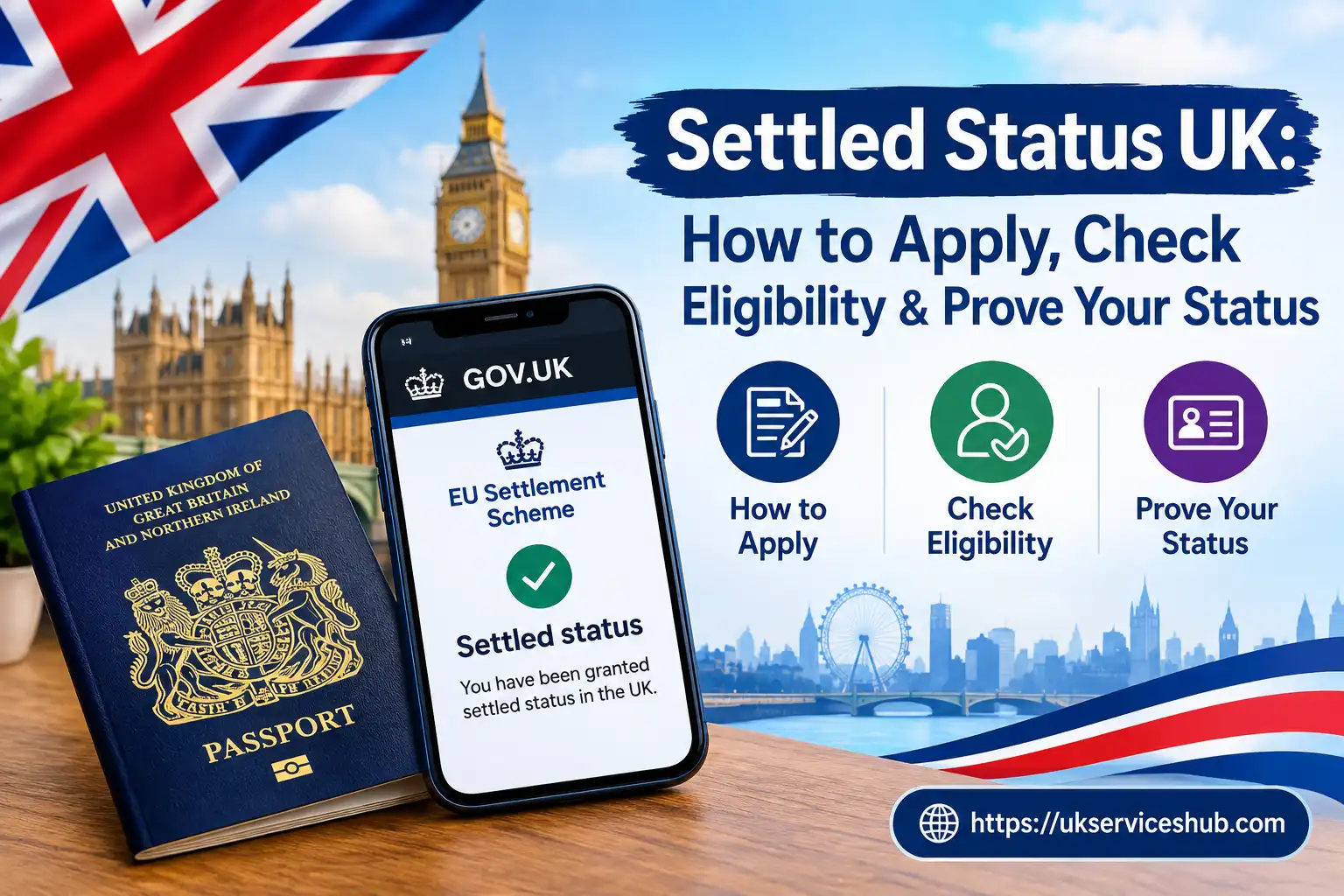
Settled status gives eligible EU, EEA and Swiss citizens, along with certain family members, the right to continue living in the UK without the time limits that apply to temporary immigration permission. If you are planning to apply, it is important to understand the eligibility rules, residence requirements, documents you may need and how to manage your status after applying.
This guide explains how the application process works, who may qualify, what evidence can support your application, and how to check or update your details. Whether you are applying for the first time or moving from pre-settled status, you’ll find clear, practical information to help you understand the process and avoid common problems.Visit our homepage for more information Click Here.
What Is Settled Status?
Settled status is an immigration status under the EU Settlement Scheme (EUSS) for eligible EU, EEA and Swiss citizens and certain family members who have built up the required residence in the UK.
For most applicants, the key requirement is 5 years of continuous residence. People who already hold pre-settled status can normally move to the settled category once they meet the residence requirements.
The main EUSS application deadline However, the scheme remains open in specific circumstances, including eligible people with later deadlines and those who can show reasonable grounds for making a late application.
This matters because the route is not simply about how long you have lived in Britain. Your nationality or family relationship, arrival date, residence history and circumstances can all affect eligibility.
Who Can Apply for Settled Status?
For most people, eligibility is connected to living in the UK
You may qualify if you are:
There are also special categories with different rules and deadlines. For example, some children, joining family members and people whose immigration circumstances changed after the original deadline may have another route into the scheme.
Who normally does not need to apply?
You generally do not need the EUSS if you already have:
British citizens cannot apply to the EU Settlement Scheme.
Understanding the 5-Year Residence Requirement
The most important part of many applications is continuous residence.
For a standard first application, you generally need 5 years of continuous residence in the UK, the Channel Islands or the Isle of Man. In the usual situation, this means not being outside those areas for more than 6 months in any 12-month period, although exceptions can apply.
If you already have pre-settled status, the rules for moving to status include specific absence limits. GOV.UK currently states that you may be eligible if you have not been outside the UK, Channel Islands or Isle of Man for more than either 30 months in the last 5 years or 6 months in any 12-month period, subject to exceptions.
This is why travel history should be checked carefully before submitting an application.
Can you qualify before five years?
In some circumstances, yes. GOV.UK gives examples including certain children of people with settled and some people whose employment circumstances mean they qualify under specific rules.
So, do not assume that everyone must wait for exactly five years before checking their position.
How to Apply for Settled Status
The application is completed online through the UK government’s EU Settlement Scheme service.
Before you start
Have the following information ready:
The Home Office may be able to check residence automatically using your National Insurance number and relevant government records. If those records do not establish the required residence, you may be asked for additional documents.
Application process
There is no application fee for the EU Settlement Scheme.
Settled Status Login: How to Access Your Account
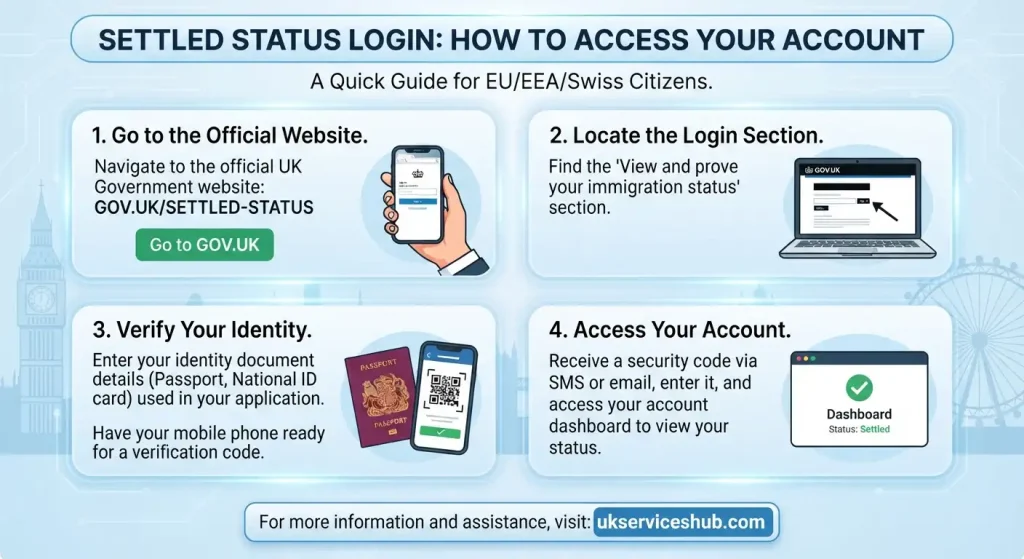
If you are searching for settled status login information, you normally need to use your UKVI account or the relevant GOV.UK service to view your digital immigration status.
Login steps
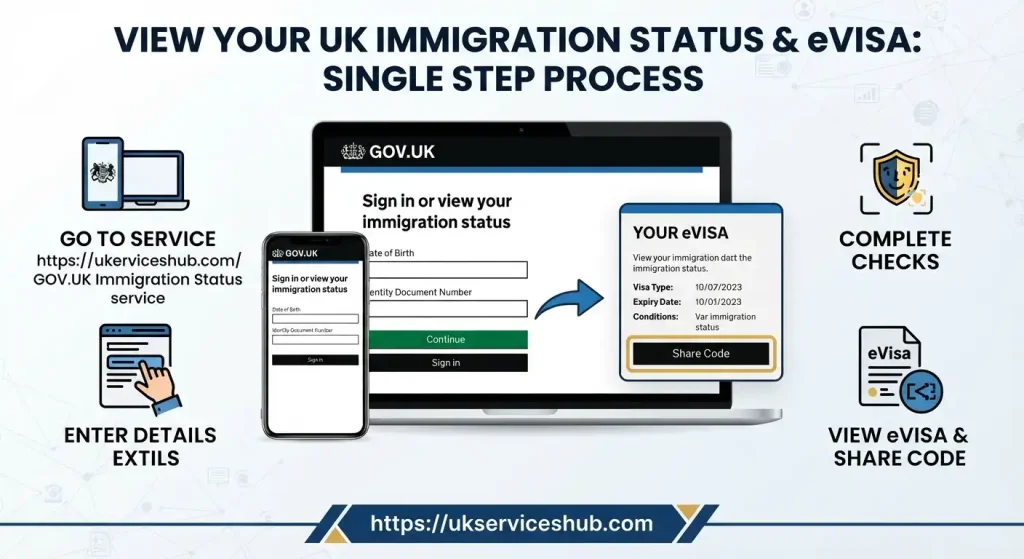
Your online account is particularly important because EUSS status is digital. Employers, landlords and other organisations can use a share code to check relevant rights where the service allows it.
Important: Use GOV.UK rather than relying on third-party websites when accessing your immigration account.
What Evidence Do You Need?
The evidence required depends on your circumstances.
For many applicants, the Home Office first tries to establish residence through existing government records. If the automated check confirms the required period, you may not need to upload separate residence documents.
If further proof is requested, useful evidence can include documents that demonstrate where you lived and how long you were resident in the UK.
Examples may include:
The exact evidence accepted depends on the circumstances, so avoid submitting large amounts of unrelated paperwork. The aim is to provide clear evidence that supports the particular requirement being checked.
Evidence for family members
If your application is based on a family relationship, you may also need to prove:
Examples of relationship evidence can include birth, marriage or civil partnership documents.
What If You Missed the Deadline?
Missing the original deadline does not automatically mean that you can never apply.
The main deadline for most applicants was GOV.UK confirms that late applications can still be considered where the applicant has reasonable grounds for the delay or where a different deadline applies.
Examples of circumstances that may support a late application include:
If you apply late, you should provide evidence explaining why you could not apply earlier and, where required, covering the period since the relevant deadline.
Moving From Pre-Settled to Settled Status
Many people now searching for apply for settled already hold pre-settled status.
If that applies to you, check your residence history and current UKVI account details before starting another application.
The Home Office has introduced an automatic conversion process for eligible pre-settled holders. Your status may therefore be converted without you making a new application. You may also be able to apply yourself once you qualify.
If your identity document or personal information has changed since your earlier application, GOV.UK says you must update your UKVI account.
A useful check before applying
Ask yourself:
Do not submit a second application unnecessarily if the Home Office has already confirmed that it is considering you for automatic conversion.
How to Check Your Status After Applying
After submitting an application, you can receive information from the Home Office about the progress or outcome.
Once your status has been granted, your immigration position is available digitally. You can use the online service to view it and prove relevant rights to other organisations.
If you need to prove your status
You can generally:
The organisation can then view the relevant information through the official system.
Updating Your Details
Keeping your UKVI account accurate is important, particularly if you change the identity document you use for travel.
You may need to update information such as:
GOV.UK advises EUSS status holders to keep valid travel documents linked to their digital account. This can help prevent unnecessary problems when travelling.
If the online service does not allow you to correct an issue, you may need to contact the UKVI Resolution Centre.
What Rights Does Settled Status Give You?
A successful EUSS settled grant provides a permanent immigration status under the scheme, subject to the rules that apply to that status.
It can make it easier to demonstrate your right to live in the UK permanently. You can also use the digital status system to prove relevant rights, such as the right to work, where applicable.
It is still sensible to keep your UKVI account and travel-document information up to date rather than assuming that receiving the status means nothing else needs attention.
Common Problems With an Application
My residence cannot be confirmed automatically
This does not necessarily mean that you are ineligible. You may be asked to provide additional documents showing your residence.
My passport details have changed
Update your UKVI account before proceeding where the guidance requires it. You cannot update an identity document through the ID Check app itself.
I cannot access my online status
Check that you are using the current details linked to your UKVI account. If the information is incorrect or you continue to have access problems, GOV.UK advises contacting the appropriate UKVI support service.
I have been outside the UK for a long time
Review the continuous residence rules carefully. Long absences can affect eligibility, although exceptions exist for certain circumstances.
I missed the application deadline
You may still have an option if you can demonstrate reasonable grounds for the delay or another later deadline applies to you. Evidence will normally be important.
Settled Status vs Pre-Settled Status
| Feature | Settled status | Pre-settled status |
|---|---|---|
| Main purpose | Permanent residence under the EUSS | Temporary status while qualifying residence is built |
| Typical residence position | Usually 5 years’ continuous residence | Usually less than 5 years when granted |
| Application fee | Free | Free |
| Digital status | Yes | Yes |
| Can it lead to status? | Already at the settled stage | Eligible holders may move to settled status |
| Automatic conversion | Not applicable | Some eligible holders may be automatically converted |
The exact position depends on your circumstances, so the table should be treated as a general guide rather than a substitute for checking the official eligibility rules.
Practical Tips Before You Submit
A few checks can make the process easier:
Final Checklist
Before you finish your application or check an existing status, make sure you have:
The most important point is to bas
Frequently Asked Questions
Conclusion
Understanding settled status can make it easier to manage your right to live, work and study in the UK. Before applying, check whether you meet the eligibility and residence requirements and make sure you have the necessary evidence to support your application.
Once your application is approved, you can use your UKVI account to view your digital immigration status and prove your rights when required. If you already have pre-settled status, it is also important to understand when you may be eligible to move to settled status.
Keeping your passport and personal details updated with UKVI can help prevent problems when travelling or proving your status. For the latest requirements and application guidance, always check the official UK government information before making an application.
Read more..