
UCAS Guide 2026: Registration, Application Process, Personal Statement, Deadlines, Offers & Clearing

UCAS is the main application service used by students applying to many universities and colleges across the UK. Whether you’re starting your application for the first time or checking what happens after submission, understanding each stage can make the process much easier to manage.
From UCAS login and registration to choosing courses, preparing your personal statement and meeting important deadlines, there are several steps to complete before an application is ready to submit. After applying, students also need to understand how offers work and what to do if they don’t receive the outcome they expected.
This 2026 guide explains the application process in straightforward terms, including course choices, UCAS points, the UCAS Hub, personal statement requirements, application deadlines, offers, Extra and Clearing. It is designed to help students and parents stay organised and make informed decisions throughout the university application journey.Visit our homepage for more information Click Here
What Is UCAS?
UCAS is the central admissions service used for undergraduate university and college applications in the UK. Instead of completing a separate application for every university, students can submit their details through one application and select up to five course choices in most cases.
The system helps students manage their applications while universities and colleges use the submitted information when making admissions decisions.
The application process involves more than simply selecting a university. Students need to research suitable courses, understand entry requirements, prepare their personal statement, arrange a reference and make sure everything is submitted before the relevant deadline.
For official information, students should always check the latest guidance on the official UCAS website.
UCAS Registration: How to Get Started
The first stage is creating an account and beginning the application. Students can register online and use their account to work through the application at their own pace.
The UCAS Hub provides a central place for managing the application and accessing information about university choices and the application journey.
What to prepare before registering
Having key information available can save time. Depending on the student’s circumstances, this may include:
It is sensible to begin researching courses before filling in the application. Entry requirements, course content, location, placement opportunities and graduate prospects can all affect which choices make sense.
UCAS Login: How to Access Your Application
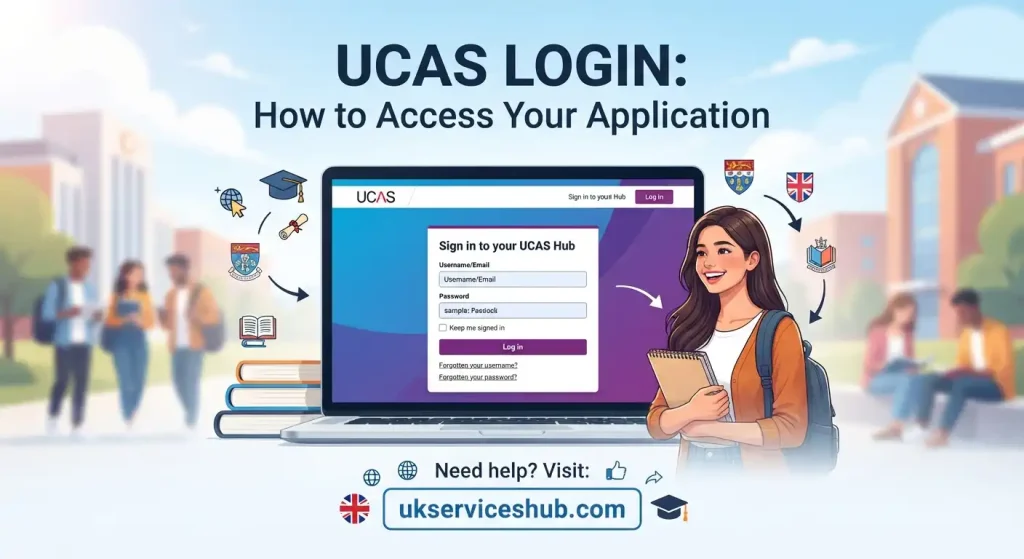
Once registration is complete, students can return to their application using their account details.
UCAS login steps
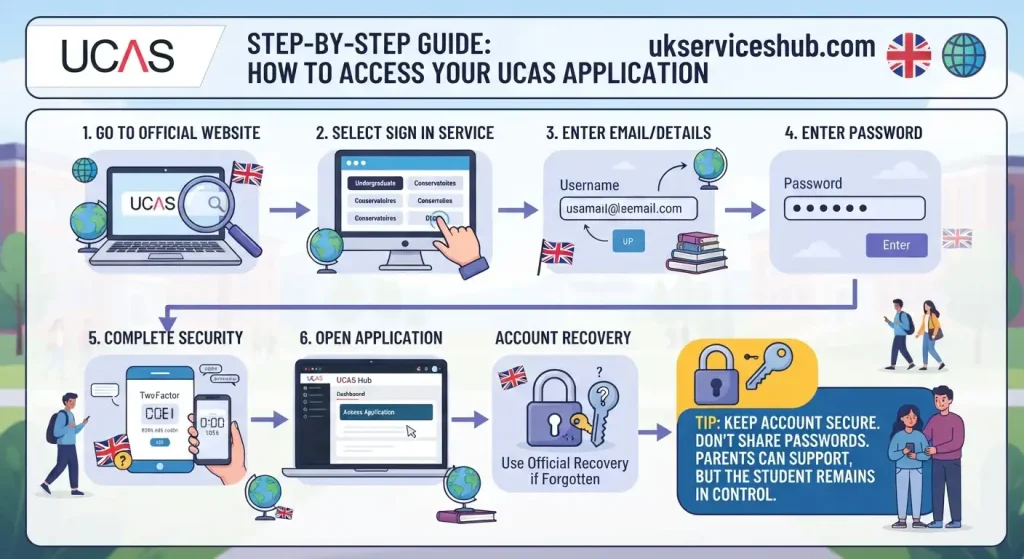
If a password has been forgotten, use the official account recovery options rather than creating another application unnecessarily.
Tip: Keep account details secure and avoid sharing passwords with other people. Parents can support a student with the application, but the student should remain in control of their own account.
Understanding the University Application Process
A strong application normally starts with course research rather than the form itself. Students should first identify subjects they genuinely want to study and then compare suitable universities.
A useful approach is to look at:
Students can then create a balanced list rather than choosing courses based only on university reputation.
The application should also be checked carefully before submission. Incorrect qualification information, missing details or rushed written answers can create avoidable problems.
How Many Courses Can You Choose?
For most undergraduate applications, a student can select up to five choices.
These choices can be arranged in different ways. For example, someone could choose the same subject at several universities or select related courses at different providers.
The key is to make the choices realistic. A sensible list may include courses that match the student’s predicted grades as well as some more ambitious options.
Students should also remember that some subjects have special application arrangements or earlier deadlines. Medicine, dentistry, veterinary medicine and applications to Oxford and Cambridge are particularly important examples.
Understanding UCAS Points and Entry Requirements
UCAS points are part of the tariff system used to compare qualifications and grades. They can help students understand how different qualifications may translate into a common points scale.
However, not every university or course uses tariff points in exactly the same way. Some courses give specific grade requirements instead, such as asking for particular A-level grades.
For this reason, students should always read the actual entry requirements for each course rather than relying only on a points total.
UCAS Points Calculator
A ucas points calculator can be useful when checking how qualifications and grades correspond to tariff points.
For example, a student with several qualifications may want to understand the tariff value of their grades before comparing course requirements. The calculator is a useful reference tool, but it should not replace checking the university’s own requirements.
Remember: meeting a tariff requirement does not automatically guarantee an offer. Universities can consider other factors, including subject requirements and the competitiveness of a course.
Writing the Personal Statement
The personal statement is an important part of the application because it gives students an opportunity to explain their interest in the subject and demonstrate preparation for university study.
For 2026 entry, the format changed from one continuous piece of writing to three structured questions. The total limit remains 4,000 characters, including spaces.
The three questions are:
- Why do you want to study this course or subject?
- How have your qualifications and studies helped you prepare for this course or subject?
- What else have you done outside education to prepare, and why are those experiences useful?
Each section needs at least 350 characters, while the available 4,000 characters can be distributed across the three answers according to what best supports the application.
What makes a good personal statement?
Students should focus on evidence rather than simply making claims.
For example, instead of saying that they are “passionate” about a subject, they can explain what sparked their interest, what they have explored independently and what they learned from that experience.
Useful material can include:
The strongest answers connect experiences to the chosen subject.
Keep Your Application Relevant
Students can apply for courses with different titles, but the choices should still make sense together.
For instance, someone applying for economics at several universities can discuss their interest in economic issues, relevant study and wider reading. If the courses combine economics with different subjects, the application should still demonstrate why the student’s academic interests suit the range of choices.
Avoid trying to write separately for every university. The application needs to work across the selected courses.
A collection of unrelated choices can make it harder to demonstrate a clear academic direction.
UCAS Deadlines You Need to Know
Deadlines are one of the most important parts of the process. Missing an equal-consideration deadline does not always make an application impossible, but universities and colleges may not be required to consider a late application equally.
For 2026 entry, the key dates included:
| Stage | 2026 date |
|---|---|
| Applications opened | 13 May 2025 |
| Completed applications could be submitted | 2 September 2025 |
| Oxford, Cambridge, medicine, dentistry and veterinary deadline | 15 October 2025 |
| Main undergraduate equal-consideration deadline | 14 January 2026 |
| Extra opened | 26 February 2026 |
| Main application deadline before Clearing | 30 June 2026 |
| Clearing opened | 2 July 2026 |
| Final 2026 application deadline | 24 September 2026 |
These dates apply to the 2026 cycle and should not be assumed for future years. Always check the current UCAS timetable before planning an application.
Students applying through a school or college should also follow the internal deadline set by their institution. This gives staff time to check information, prepare the reference and submit the application.
What Happens After You Submit?
Submitting the form is not the end of the process. Universities and colleges review applications and may make decisions at different times.
A student may receive:
A conditional offer usually depends on achieving specified grades or meeting other requirements.
Students should read each decision carefully and keep track of any conditions attached to an offer.
Understanding University Offers
Once decisions begin arriving, the next task is deciding how to respond.
Students may normally select a firm choice and, where eligible, an insurance choice. The firm option is the preferred course, while the insurance choice provides another route if the conditions of the firm offer are not achieved.
Do not choose an insurance course simply because it has lower grades. It should still be a course the student would genuinely be happy to attend.
Before accepting an offer, check:
The response deadlines depend on when decisions are received, so students should check their individual timetable rather than relying on a general date.
What Is Clearing?
Clearing is a UCAS service that helps eligible students find available university and college places.
It can be particularly useful for students who:
For 2026 entry, Clearing opened on 2 July, while applications received after 30 June were automatically entered into Clearing.
Clearing should not automatically be viewed as a failure. It is another route into higher education, provided the student finds a suitable course and meets its requirements.
How to approach Clearing
Start by searching available courses and checking their entry requirements. Then contact universities where appropriate and discuss availability.
Before accepting a place, confirm:
A student should never accept a course simply because it is available. The course still needs to be a good academic and personal fit.
What Is UCAS Extra?
Extra can help eligible applicants who have used all five choices but are not holding an offer.
For the 2026 cycle, Extra opened on 26 February. It allows eligible students to apply to another course one at a time rather than making another set of five choices.
This can be useful before Clearing, particularly for students who want another opportunity to secure a university place.
Common Mistakes to Avoid
A well-prepared application does not need to be complicated, but several mistakes can cause unnecessary problems.
Leaving everything until the deadline
Writing the application at the last minute makes it harder to check details and improve written sections.
Choosing courses without checking requirements
Always compare the actual requirements of each course. Do not assume that similar course titles have identical conditions.
Making the personal statement too generic
Admissions teams need to see why the student is interested in the subject and how their experiences have prepared them.
Ignoring internal school deadlines
A school or college may require the application earlier than the official submission deadline so staff can complete their checks and reference.
Treating Clearing as a last resort
Clearing can provide genuine opportunities, but students should research available courses carefully rather than waiting until the final moment.
A Practical Application Checklist
Before submitting an application, students can use this checklist:
Frequently Asked Questions
Final Thoughts on UCAS Applications
Planning your UCAS application early can make the university admissions process much easier to manage. From registration and course selection to writing a strong personal statement and meeting key deadlines, each stage deserves careful attention.
Before submitting your application, check your course entry requirements, review your UCAS points, and make sure all personal and education details are accurate. Once applications are submitted, keep track of university decisions, understand the difference between conditional and unconditional offers, and respond within the required timeframe.
If your original choices do not result in a place, UCAS Extra and Clearing can provide alternative routes to university. Staying organised and checking the latest official information throughout the process will help you make informed decisions about your next step in higher education.
Read more..