Land Registry Portal UK 2026: Search, Title Number & Property Information Guide
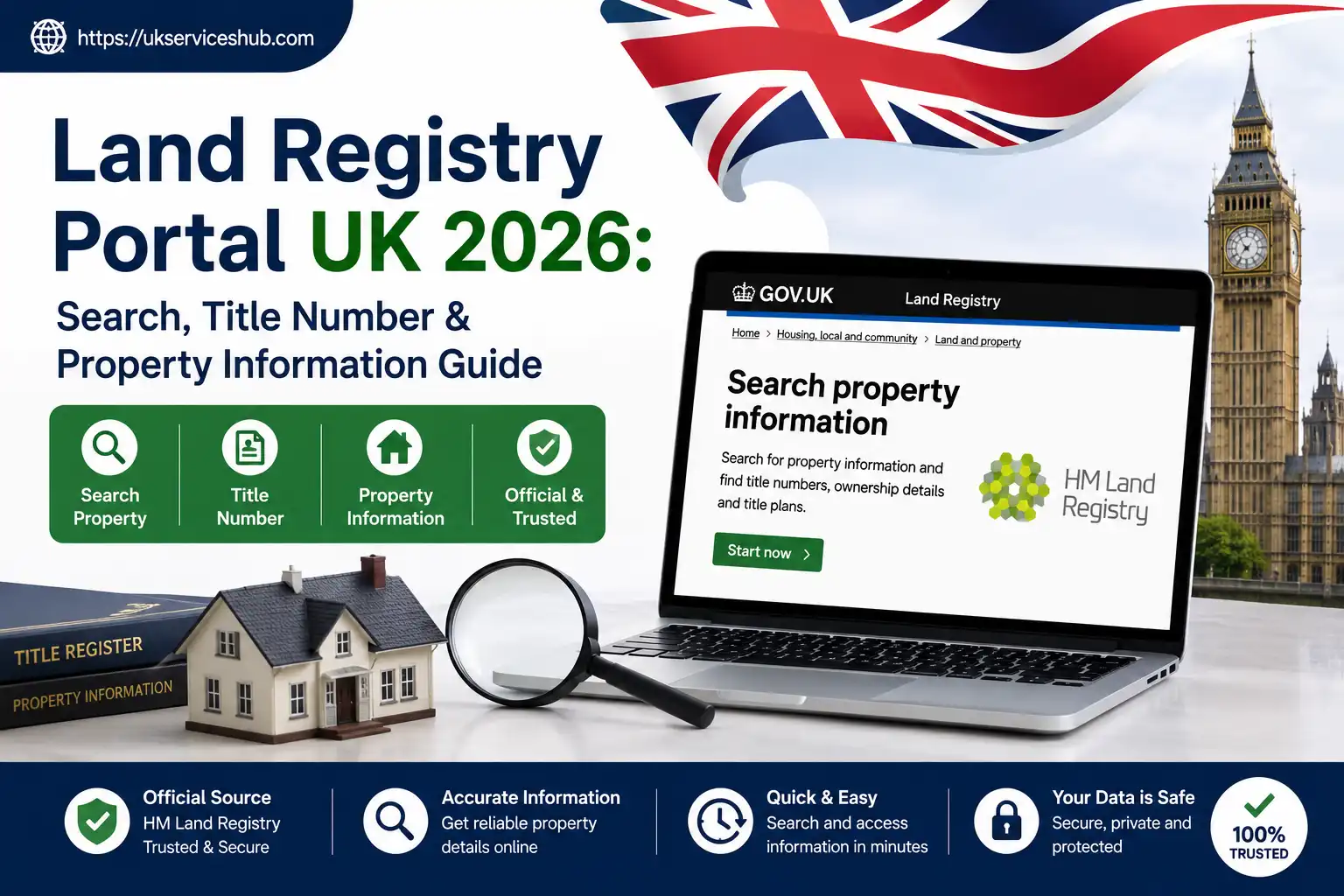
Land Registry Portal UK provides a convenient way to access property and land information in England and Wales. Whether you want to check a property’s title number, find registered ownership details, view the Title Register or obtain a Title Plan, the online service can help you find the information you need. This guide explains how the Land Registry Portal works, what property details you can search for, the documents available online, and the costs involved. It also covers common Land Registry questions to help you use the service confidently.Visit our home page for more information Click Here
Land Registry Portal: Which Service Should You Use?
HM Land Registry’s online services cover different types of users and tasks. Before signing in, it is worth identifying which service matches what you are trying to do.
| Service | Main users | Typical purpose |
|---|---|---|
| GOV.UK property search | General public | Find property information and purchase title documents |
| HM Land Registry e-Services Portal | Professional and business users | Land-registration and information services |
| Property Alert | Property owners and other users | Monitor registered properties for activity |
| Index Map search | Users unable to identify a title normally | Help identify title numbers or establish whether land is registered |
Quick answer
If you are a homeowner, buyer, tenant or another member of the public who wants information about a property, start with the GOV.UK property search rather than the professional Land Registry Portal.
The public service can be used to search registered property and obtain copies of documents such as title registers and title plans.
What Is Available Through a Land Registry Search?
A property search can provide different levels of information depending on which document you request.
A basic property search may help you identify the registered property, while the title register provides more detailed legal information. A title plan shows the property’s location and general boundaries.
For online copies, GOV.UK currently lists the price as £7 for a title register and £7 for a title plan.
The information can be useful when:
How to Find a Property on the Land Registry
For most members of the public, the easiest route is the official GOV.UK property information service.
1. Open the official property search
The service covers registered land and property in England and Wales. It is not the registration system used for Scotland or Northern Ireland.
You will need to sign in to use the service. If you do not already have the required sign-in details, GOV.UK provides an option to create them. A debit or credit card is needed when purchasing downloadable property documents.
2. Enter the property’s address
Search for the property using the information you have available.
A postcode can make the search easier, while other useful details may include:
Be careful where several properties have similar addresses. Always check the displayed property details before purchasing a title document.
3. Choose the matching property
Review the search results and select the property that corresponds to the land or building you are investigating.
The results can help establish whether the property appears to be registered and what information or documents are available.
If you cannot find the expected property, do not automatically conclude that it is unregistered. Address changes, registration arrangements and alterations to land boundaries can affect how a property appears in a search.
How to Purchase a Title Register Online

Once you have identified the correct property, you can request the title information you need through the public property-information service.
Step 1: Confirm the property
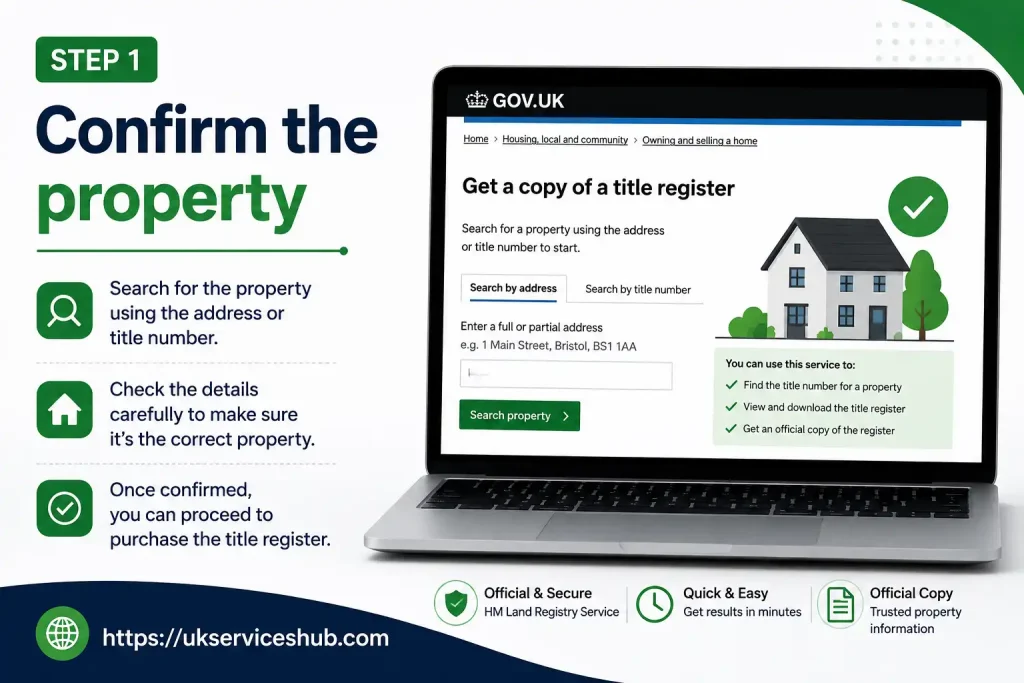
Check the address carefully before selecting a result. This is particularly important when several properties have similar addresses or when one property is associated with multiple registered titles.
Step 2: Select the document
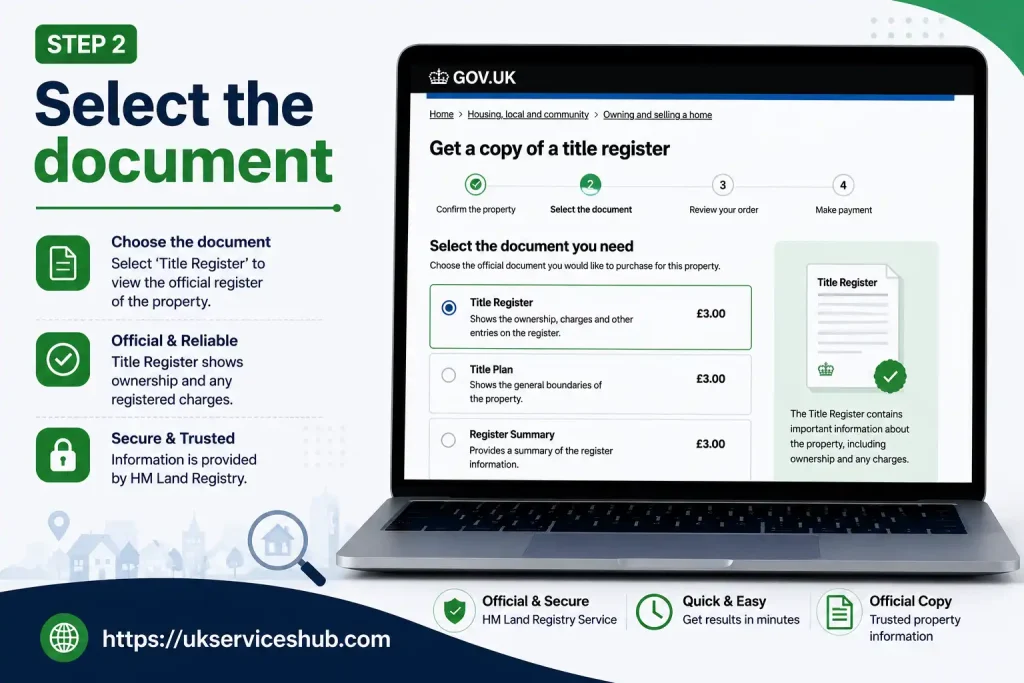
Choose the title register when you need ownership and other written legal information.
Choose the title plan when you need to see the mapped extent and general boundaries of the registered property.
You may choose both if your investigation requires written and mapped information.
Step 3: Review your selection
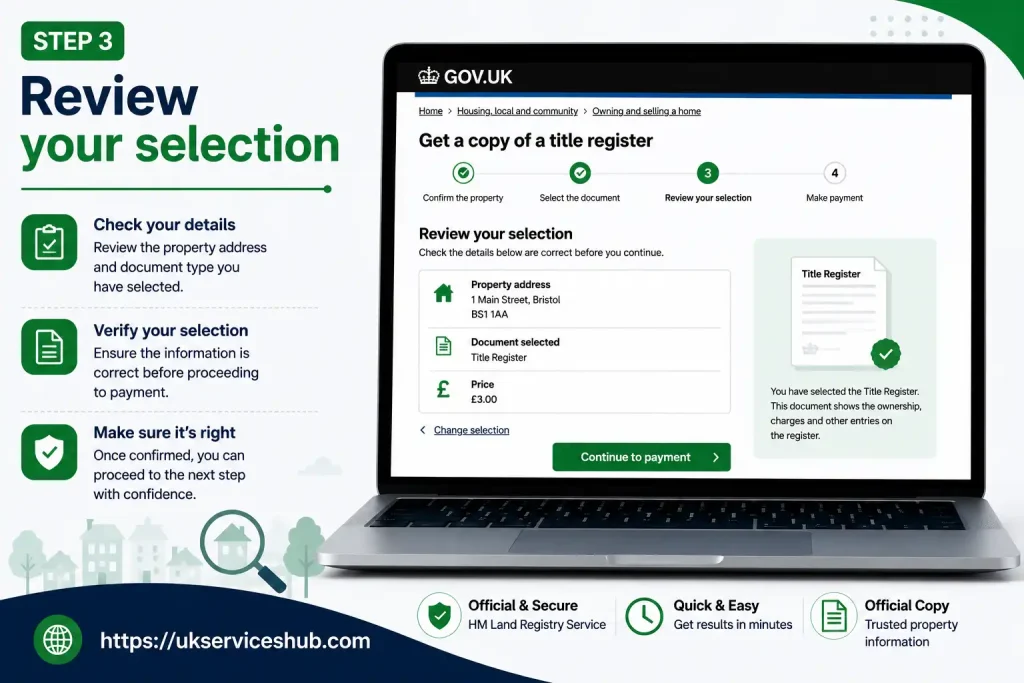
Check that you have selected the correct title and the documents you actually need before proceeding.
Step 4: Make the online payment
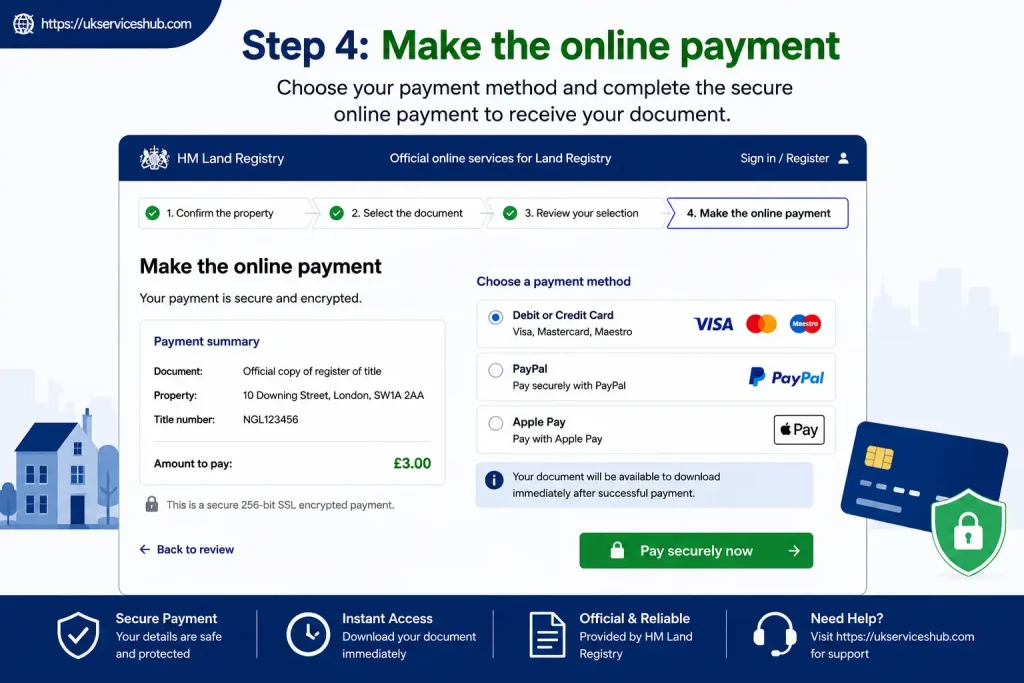
Complete the payment process provided by the public service.
Step 5: Download the document
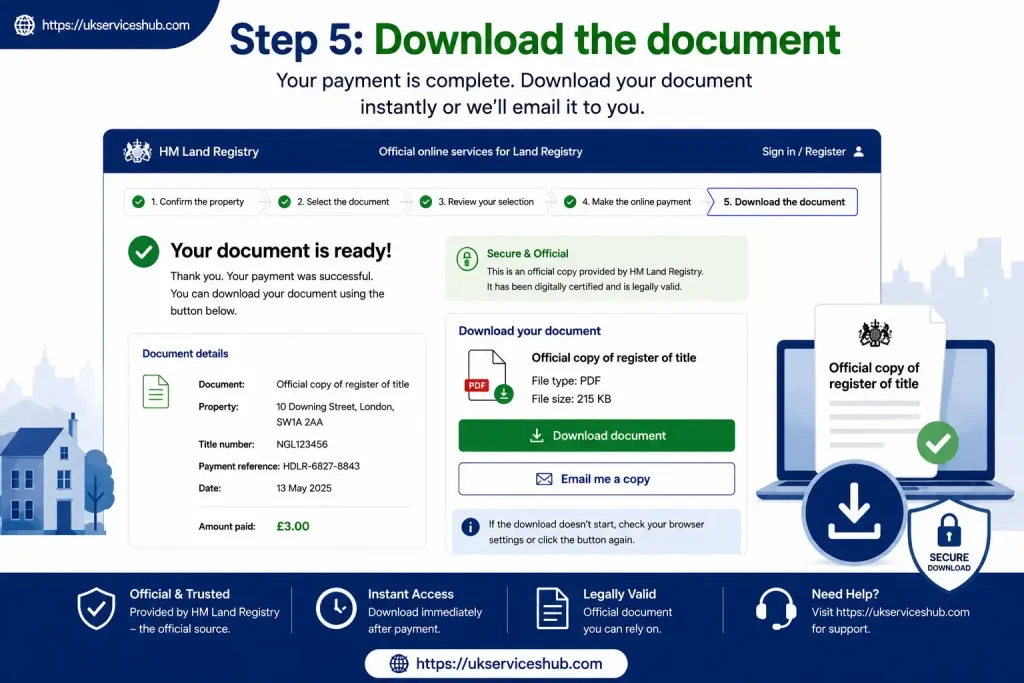
Once available, download the digital document and keep it securely if you need it for a property purchase, sale or further research.
What Does the Land Registry Title Register Tell You?
The title register is one of the most useful documents when you need detailed information about registered property.
It normally contains the property’s unique title number along with important legal and ownership information.
Depending on the property, the register can include:
This makes the title register particularly useful for property buyers, owners, conveyancers and anyone researching rights or restrictions connected with registered land.
What is a title number?
A title number is the unique reference assigned to a registered property or piece of land by HM Land Registry.
It can be particularly useful when dealing with professional property searches or when referring to a specific registered title.
If you are carrying out a land registry UK title number search, the public property search service is generally the appropriate place to begin when you know the property’s address.
What Is a Land Registry Title Plan?
A title plan is a map associated with the registered title. It helps show the property’s location and the general boundaries of the registered land.
There is an important limitation to remember: the boundary shown on a title plan should not normally be treated as an exact legal boundary.
The red edging or other markings on a title plan indicate general boundaries rather than establishing the precise position of every physical boundary. If you are dealing with a boundary dispute, you may need to consider the title register and any documents referred to within it rather than relying on the plan alone.
Property summary vs title register vs title plan
| Document | What it is useful for |
|---|---|
| Property summary | Initial property and registration check |
| Title register | Ownership, title number, tenure, restrictions and recorded rights |
| Title plan | Property location and general boundaries |
Choosing the correct document can save money and avoid buying information you do not actually need.
Is There a Land Registry Portal for Northern Ireland?
The land registry portal NI search term can be misleading because HM Land Registry’s system applies to England and Wales, not Northern Ireland.
Northern Ireland has its own land registration arrangements. Therefore, someone searching for Northern Irish property should not assume that an HM Land Registry search will provide the relevant records.
The same distinction applies to Scotland, which has a separate land registration system.
What If the Land Registry Portal Is Down?
If you are searching for land registry portal down, first establish which online service is unavailable.
A problem with the professional e-Services Portal does not necessarily mean that the public GOV.UK property search is unavailable. Likewise, difficulty signing in may be caused by account or browser issues rather than a wider HM Land Registry outage.
Before trying again, check:
For security, avoid entering payment or account details into unofficial websites claiming to provide HM Land Registry access.
When Should You Use the Professional Portal?
The professional HM Land Registry e-Services Portal is more relevant when you are working with land-registration services as a professional or registered organisation.
For example, professional users may need access to services associated with:
If your only objective is to discover who owns a house or obtain a copy of a title register, the public GOV.UK route is normally more appropriate.
Important Things to Check Before Buying a Property Document
A title document can provide valuable information, but you should read it carefully rather than looking only at the owner’s name.
Pay particular attention to:
Title number:
Confirm that the document relates to the property you are investigating.
Registered proprietor:
Check the name or names recorded as the registered owner.
Tenure:
The register contains information about whether the property is registered as freehold or leasehold.
Charges and mortgages:
Look for recorded financial charges or mortgage-related information.
Restrictive covenants:
These may place restrictions on how the property or land can be used.
Easements and rights:
The register may record rights benefiting or affecting the property.
Plan and boundaries:
Remember that title plans generally show general rather than exact legal boundaries.
Key Points About the Land Registry Portal
The most important distinction is between the professional HM Land Registry e-Services Portal and the public GOV.UK property search.
If you are simply researching a property, you normally do not need professional portal access. Start with the public search, identify the correct property, and then decide whether you need the title register or title plan.
For professional land-registration work, the e-Services Portal provides a different set of services intended for business and professional customers.
The correct route therefore depends on what you need to accomplish—not simply on searching for the phrase “Land Registry Portal”.
Land Registry UK Title Number Search: Finding and Using a Title Number
A title number is the unique reference assigned by HM Land Registry to a registered property or parcel of land in England and Wales. Once you have this reference, identifying the correct registered title and its related documents becomes much easier.
If the title number is unknown, you can normally begin by searching for the property using its address. When you obtain the title register, the title number is generally shown at the top of the document.
HM Land Registry prepares a register for each registered title and, in most cases, an associated title plan.
Why Does a Title Number Matter?
The title number provides a precise way to refer to a registered property. It can be useful for both members of the public and professional users dealing with HM Land Registry.
You may need it to:
For professional customers, having the correct title number can make requests for official copies and other property information more straightforward.
Can’t Find the Property? Try an Index Map Search
An ordinary property search does not always produce the result you expect. This can happen when an address has changed, land has been divided or the property is recorded differently from the address you are using.
In these situations, an Index Map Search can be useful. HM Land Registry’s index map contains information about land that is registered or currently going through the registration process.
An index map search can help establish the title number when a property cannot be identified through the normal search route.
Situations Where an Index Map Search May Help
Consider this option when:
You cannot simply browse the index map online yourself. An application is required, together with enough information for HM Land Registry to identify the land.
Where an address is insufficient, you may need to provide a suitable plan or an Ordnance Survey map reference.
The stated cost for an index map search is £8 for an area containing up to five registered titles.
Using the Land Registry Portal as a Professional Customer
The Land Registry Portal search is separate from the public GOV.UK property-information service.
Professional and business e-Services customers can use the portal for information services and other land-registration activities. For example, HM Land Registry guidance explains that portal users can request official copies through Information services → Request official copies.
If you have authorised access through an organisation, sign in using the credentials provided to you. Keep your user ID, password and authentication information private.
Forgotten Your Portal Login Details?
If you cannot remember your credentials, use the recovery options available through the official portal. Avoid entering account information into websites that imitate HM Land Registry.
Where self-service recovery does not resolve the problem, use official HM Land Registry support information rather than relying on an unofficial login page.
Land Registry Portal Down: Steps to Take
People searching for land registry portal down may be dealing with anything from a temporary technical problem to an account-specific login issue.
Before assuming that HM Land Registry is completely unavailable, identify which part of the service is affected:
Troubleshooting a Portal Access Problem
1. Use the official website directly
Open the official HM Land Registry service rather than following an unfamiliar search result or outdated bookmark.
2. Refresh or change your browser
Make sure your browser is up to date, then reload the page. Trying another supported browser can also help identify a local browser problem.
3. Check whether other authorised users can sign in
If colleagues can access the service while you cannot, the issue may be specific to your account or credentials rather than a wider outage.
4. Check payment status before trying again
If a payment or document request appears to have failed, confirm whether the transaction was actually processed before submitting another payment.
5. Use official support information
If the problem continues, refer to HM Land Registry’s official guidance and support channels.
Important: A failed search does not necessarily mean that a property is unregistered. Technical access problems, address details and title identification are separate issues.
Land Registry Portal NI: Check the Correct Jurisdiction
The phrase land registry portal NI can lead to confusion because HM Land Registry does not handle land registration for Northern Ireland.
HM Land Registry covers England and Wales. Scotland and Northern Ireland operate separate land-registration systems.
Before beginning a property search, make sure you are using the authority responsible for the property’s location:
| Location | Relevant land-registration authority |
|---|---|
| England | HM Land Registry |
| Wales | HM Land Registry |
| Scotland | Registers of Scotland |
| Northern Ireland | Land & Property Services |
This distinction is important. Searching for a Northern Irish property through the England-and-Wales HM Land Registry service is not the correct way to obtain its land record.
Why the Title Number Can Be More Useful Than the Address
An address is convenient for finding a property, but the title number identifies the registered title itself.
This difference becomes particularly important where a property contains more than one title, includes adjoining land or has a complicated ownership structure.
For instance, different parts of a building or connected pieces of land may have separate registered titles. In such cases, an address search may not reveal the full picture immediately.
For a typical residential property, a sensible approach is to search by address, identify the relevant title number and then examine the register. If the property involves several plots, rights or boundary issues, professional property advice may be appropriate.
What Should You Check in the Title Register?
Once you have the register, look beyond the owner’s name. The document is divided into sections containing different types of legal information.
A — Property Register
The Property Register describes the registered property and its tenure. It can also contain details of rights that benefit the property.
B — Proprietorship Register
The Proprietorship Register identifies the registered proprietor and may contain restrictions affecting how the title can be dealt with.
C — Charges Register
The Charges Register can record mortgages, restrictive covenants and other burdens or rights affecting the property.
Reading all relevant sections matters. A title register should not be viewed simply as an ownership record because it can contain restrictions and other legal information that may affect the use, sale or transfer of the property.
Key Takeaways for a Land Registry Title Number Search
How to Read a HM Land Registry Title Register
A Land Registry Portal search is only the first step when researching a property. The title register can reveal important details about the registered owner, tenure, restrictions, mortgages and other rights affecting the land.
HM Land Registry organises the register into three main sections:
Reading these sections in order makes it easier to understand what the title actually records rather than focusing only on the owner’s name.
A Register — Property and Tenure
The A section describes the registered property and its legal tenure.
It may show whether the title is freehold or leasehold and can include information about rights that benefit the property.
For leasehold properties, the register may refer to the lease under which the property is held. This is especially important when purchasing a flat because the register itself may not contain every provision contained in the underlying lease.
What to check
Look for:
If the property is leasehold, the lease itself may need to be reviewed alongside the title register.
B Register — Registered Ownership
The B section identifies the registered proprietor, which is why it is often the first part buyers look at.
It can contain information such as:
What does a restriction mean?
A restriction can control how certain dealings with the registered title are registered.
For example, a restriction may require specific consent or a certificate before a transaction can be registered. Therefore, seeing the owner’s name alone does not tell you everything about the owner’s ability to deal with the property.
C Register — Charges and Other Burdens
The C section records burdens affecting the registered property.
Depending on the individual title, it may include:
Not every title will contain identical entries. The information depends on the property’s individual registration history and the matters recorded against it.
Title Register vs Title Plan: What Is the Difference?
During a land registry portal search, it is easy to assume that a title register and title plan provide the same information. They serve different purposes.
| Document | Main purpose | Useful for |
|---|---|---|
| Title Register | Written information about the registered title | Ownership, tenure, restrictions and charges |
| Title Plan | Map showing the registered extent | Location and general boundaries |
| Property Summary | Basic property information | Initial checks before purchasing documents |
The register explains what is recorded about the title, while the plan helps you understand where the registered land is located.
For a detailed property investigation, obtaining both can therefore be more useful than relying on either document alone.
Understanding Land Registry Property Boundaries
Boundary information is an area where caution is important.
The markings on a Land Registry title plan generally indicate the general boundaries of the registered title. They should not automatically be interpreted as an exact measurement of the legal boundary.
A title plan can help you understand the approximate extent and location of registered land, but it is not necessarily a detailed boundary survey.
What to review when checking a boundary
Consider the following together:
If there is disagreement with a neighbour, relying only on the visual position of a line on a Land Registry plan may not settle the matter.
How Much Does a Land Registry Search Cost?
The price depends on the service and document requested. Based on the information provided for this guide, the standard online prices are:
| Request | Online price |
|---|---|
| Title Register | £7 |
| Title Plan | £7 |
| Title Register + Title Plan | £14 |
| Index Map Search | £8 for up to five titles |
Because government fees can change, check the current GOV.UK property-information service before paying.
For a basic property search, it is also sensible to use the official HM Land Registry or GOV.UK service rather than paying an unrelated third-party website to perform the same search.
Are Online Copies Official Copies?
Not necessarily. This distinction is important when a document is required for a formal legal purpose.
A document obtained through the public property-information service can be useful for research and information, but it should not automatically be assumed to satisfy a request for an Official Copy.
HM Land Registry has a separate process for obtaining official copies.
Professional customers can request them through the e-Services Portal, while other applicants can use the appropriate HM Land Registry procedure.
If a solicitor, lender, court or another organisation specifically asks for an official copy, check its requirements rather than assuming that an ordinary online copy will be accepted.
How Professional Users Request Official Copies
Professional users can use the HM Land Registry e-Services Portal to request official copies.
The process generally involves:
If you are simply checking a property for personal research, you should not assume that professional portal registration is necessary.
When Is Form OC1 Used?
Form OC1 is used to request official copies of register and/or title-plan information.
It is relevant when an official copy is required rather than an ordinary copy obtained for general information.
Before submitting an OC1 application, check the latest HM Land Registry instructions, including the current fee and submission requirements. Older guides and third-party websites may contain outdated information.
Can You Find Historical Land Registry Information?
Sometimes the current register does not provide everything you need.
Historical property information can be relevant when researching previous ownership, older transactions or earlier title arrangements. It may also become important where a property has been divided, transferred or altered over time.
Do not assume that every historical detail will appear in the current title register. Earlier titles or other historical documents may need to be requested through the appropriate HM Land Registry service.
Where a property has changed significantly over the years, several current or former titles may need to be considered together.
What If the Property Has More Than One Title?
A land registry UK title number search can become confusing when one property address is connected with several registered titles. An address does not always represent a single title.
For example, a property may include:
Because of this, don’t assume that the first title appearing in the search results represents everything connected with the property.
What should you do?
If you’re buying a property and several potentially related titles appear, ask your conveyancer to confirm which titles are included in the transaction.
That approach is safer than assuming that every nearby or similarly named title forms part of the property you are purchasing.
What If You Don’t Know the Title Number?
You do not normally need the title number to start an ordinary property search.
Begin with the property’s address using the public property-information service. If the address does not identify the land you need, an Index Map Search may be the next option.
According to the supplied guidance, an index map search can help establish whether land is registered and, where appropriate, identify its title number.
For land without a standard postal address, you may need to provide a plan or other information that clearly identifies the relevant area.
Land Registry Portal Search Problems: Why Can’t You Find the Property?
A failed land registry portal search does not automatically mean that HM Land Registry has no record of the property.
Different issues can produce similar search results, so work through the likely causes before drawing a conclusion.
The address is not recognised
Check the details you entered, including:
The property has recently changed
Recent transactions or registration applications can affect how information appears. The details available through a search may not always match what you expect from a recent purchase, transfer or other change.
The land may be unregistered
Some land may not be registered. If so, an ordinary title-register search may not return the information you are looking for.
You’re searching the wrong jurisdiction
HM Land Registry applies to England and Wales. If the property is in Northern Ireland or Scotland, use the relevant land-registration authority for that jurisdiction.
Land Registry Portal Down: What Should You Check?
The phrase land registry portal down can describe several different problems. A login page might fail to load, an individual service may display an error, or a particular transaction may fail while other HM Land Registry services continue to work.
Before repeatedly trying the same action, check the official service and any available service information.
Professional users should also consider whether the problem could be related to:
Be careful with repeated payments
If the page stops responding after you have reached the payment stage, don’t immediately submit another payment.
First establish whether the original transaction was completed. This can help prevent duplicate charges and unnecessary confusion.
Land Registry Portal and Property Fraud Protection
Property owners can also use HM Land Registry’s Property Alert Service to receive notifications about certain activity affecting monitored properties.
Property Alert is different from a normal land registry portal search. Instead of repeatedly checking the register yourself, the service can provide an additional warning when relevant activity occurs.
It may be particularly useful for people who:
Property Alert does not automatically prevent fraud, but receiving an alert can give you an opportunity to investigate activity that you do not recognise.
Overseas Owners and International Property Buyers
The same basic property-information principles apply when someone outside the UK wants to research property in England or Wales.
An overseas buyer can use the public property-information service to investigate registered property information, subject to the service’s normal requirements.
However, a Land Registry record is only one part of property due diligence. Depending on the circumstances, a prospective buyer may also need professional advice about:
The title register provides important information about the registered title, but it should not be treated as a complete investigation of every issue affecting a property.
Common Land Registry Search Mistakes
1. Using an unofficial property-search website
Start with GOV.UK or the official HM Land Registry service. This reduces the risk of paying unnecessary third-party charges or entering information into an unofficial website.
2. Treating the title plan as an exact boundary survey
A title plan generally shows general boundaries. It should not automatically be interpreted as a precise surveyed boundary.
3. Confusing an online copy with an Official Copy
An ordinary copy obtained for information is not necessarily the same as an Official Copy. If a solicitor, lender, court or another organisation has requested a specific document, confirm exactly what they require.
4. Searching Northern Ireland through HM Land Registry
HM Land Registry covers England and Wales. Northern Ireland has its own land-registration arrangements.
5. Assuming one address means one title
A single property address can sometimes be associated with multiple registered titles.
6. Paying twice after a technical error
If a transaction appears to fail, check its status before submitting another payment.
Which Land Registry Service Should You Use?
The appropriate service depends on what you are trying to establish.
| Your situation | Best starting point |
|---|---|
| Check who owns a property | GOV.UK property search |
| Find a title number | Property search or Index Map Search |
| View general registered boundaries | Title Plan |
| Check ownership, charges and restrictions | Title Register |
| Request professional official copies | HM Land Registry e-Services |
| Monitor a property for certain activity | Property Alert |
| Research Northern Ireland property | Relevant Northern Ireland land-registration service |
| Research Scottish property | Registers of Scotland |
For a straightforward property check, the public GOV.UK search will often be sufficient. More complicated transactions can require additional title documents or professional advice.
Part 2 Key Takeaways
When a Property Search Is Not Enough
A Land Registry Portal search is useful when you need to investigate an existing registered title, but searching the register is different from making a formal application to change it.
If you are checking ownership, reviewing a title register or looking at a title plan, the public GOV.UK property-information service may provide what you need. However, transactions such as registering previously unregistered land, transferring registered property or changing information recorded on a title can require a formal HM Land Registry application.
The appropriate application depends on the change you need to make.
Common HM Land Registry Forms and Applications
HM Land Registry uses different forms for different registration matters. Three forms that commonly arise in property transactions are FR1, TR1 and AP1.
First Registration — Form FR1
Where land has not previously been registered and needs to be registered for the first time, Form FR1 is associated with the first-registration application.
The application normally needs supporting evidence establishing the applicant’s title to the land. Because first registration can involve detailed title documents and legal issues, professional conveyancing assistance can be useful where the circumstances are complicated.
Transfer of Registered Property — Form TR1
Form TR1 may be used when registered land is transferred from one owner to another.
Typical situations can include:
TR1 is not the entire registration process. Depending on the transaction, additional documents, identity requirements and registration steps may also apply.
Changing the Register — Form AP1
Form AP1 is commonly associated with applications to change an existing registered title.
It can arise after a property transaction or when information recorded in the register needs to be amended.
Don’t choose a form solely because you have found its name online. Always check the current HM Land Registry guidance to determine which application and supporting documents apply to your particular situation.
What Is the HM Land Registry Business Portal?
The professional HM Land Registry e-Services Portal is intended for authorised business customers rather than people who simply want to browse property information.
Users can include:
Professional access can provide services that are not designed for ordinary public property searches.
If you’re simply checking a house before making an offer, there is normally no need to obtain professional portal access when the public GOV.UK property-information service can provide the information required.
How Professional Users Can Carry Out a Property Search
If you already have authorised access to the Land Registry Portal, the exact process depends on the services available to your organisation.
A typical workflow is:
Professional users should follow both HM Land Registry’s current instructions and their organisation’s internal procedures.
Overseas Entities and Property in the UK
Some overseas organisations acquiring or holding certain UK property interests can have additional registration obligations.
The Register of Overseas Entities is operated by Companies House. Where the relevant rules apply, an overseas entity may need to register and obtain an Overseas Entity ID before carrying out certain transactions involving registered property.
This process is separate from an ordinary public property search.
An overseas organisation intending to acquire or hold UK land should establish its applicable legal and reporting obligations before completing the transaction.
Property Alert: An Extra Way to Monitor a Property
Property owners can also use HM Land Registry’s Property Alert Service.
Instead of repeatedly performing a land registry portal search, Property Alert can provide notifications about certain activity involving properties you choose to monitor.
It can be particularly useful where a property is:
Property Alert is a monitoring tool rather than a replacement for legal advice or other property-security measures. Its purpose is to provide an additional warning if relevant activity occurs that you do not recognise.
Land Registry Portal Down: What Should You Do?
The search term land registry portal down can refer to several different problems. The professional login might be unavailable, a particular e-Service could return an error, or the issue could be limited to an individual account.
Start by opening the official service directly:
Check whether another service is available
If the professional portal is not working, see whether the public GOV.UK property-information service can still be accessed.
If the public service works while your professional account does not, the issue may be related to your account, permissions or authentication.
Verify your credentials
Make sure you are using the correct authorised credentials and authentication method.
Never provide your password or authentication code to someone offering unofficial portal support.
Check your browser and connection
You can try:
Avoid submitting the same transaction twice
If an application or payment appears to have failed, establish whether it was actually processed before trying again. This is especially important if a fee has already been charged.
What If HM Land Registry Cannot Find the Property?
A missing search result can have several explanations.
1. The address may have been entered incorrectly
Recheck the postcode, building number, street name and spelling.
2. The registered title may use different details
The address people use every day does not always correspond exactly with the information associated with the registered title.
3. The property may contain several titles
One address can sometimes involve multiple registered titles. You may therefore need to investigate more than one title rather than assuming that the first result represents the entire property.
4. The land may be unregistered
If no registered title can be identified, an Index Map Search may be appropriate.
5. The property may be in another jurisdiction
Confirm whether the land is in England, Wales, Scotland or Northern Ireland before deciding which registration service to use.
Can You Search Using a Title Number?
Yes. If you already know the title number, it can provide a more precise reference than an ordinary property address.
This is particularly useful when:
For most homeowners, however, not knowing the title number is not a problem. You can normally begin by searching for the property using its address.
Land Registry UK Title Number Search: A Practical Example
Suppose you’re considering buying a house and know its full address but not its title number.
Start with the address
Use the official GOV.UK property-information service to locate the property.
Identify the relevant title
Review the results carefully and determine which registered title relates to the property.
Obtain the title register
If you need information about ownership, tenure, restrictions or other recorded matters, obtain the relevant title register.
Check the title plan
If you need to understand the general registered extent of the property, obtain the corresponding title plan.
Get professional advice when something is unclear
If you discover an additional parcel of land, unusual restriction, multiple title or potential boundary issue, ask your conveyancer to investigate rather than making a legal assumption from the map or register alone.
This is generally more reliable than relying on random third-party websites to identify a title number.
Public Property Search vs Professional Portal
The difference between the two main routes can be summarised as follows:
| Feature | Public GOV.UK service | HM Land Registry e-Services |
|---|---|---|
| Basic property search | Yes | Available to authorised users |
| Address search | Yes | Available through relevant services |
| Title register information | Yes, paid document | Available through professional services |
| Title plan | Yes, paid document | Available through relevant services |
| Professional applications | No | Yes |
| Business account | Generally not required | Required for relevant services |
| Official copies | Separate process | Available through relevant professional services |
For consumers carrying out an ordinary property check, the public service is usually the appropriate starting point.
The professional portal is more relevant when acting for clients, submitting registration applications or carrying out professional land-registration work.
HM Land Registry Jurisdiction: England and Wales
Always establish where the property is located before starting a search.
England and Wales
Use HM Land Registry for registered land and property.
Scotland
Scotland has its own land-registration system operated by Registers of Scotland.
Northern Ireland
Northern Ireland has separate land-registration arrangements administered through Land & Property Services.
This is why the keyword land registry portal NI can be misleading. HM Land Registry is not the land-registration authority for Northern Ireland.
The first step in any property-information search is therefore to identify the correct jurisdiction. Once that is clear, you can choose the appropriate public search, professional service or formal registration process.
Frequently Asked Questions About Land Registry Portal UK
Conclusion
The Land Registry UK service provides a convenient way to find important information about registered property and land in England and Wales. By searching the property register, you can check details such as the title number, registered owner, tenure, title register and title plan.
For a basic property check, the online search service is often the easiest option. If you need documents for legal or official purposes, make sure you obtain the appropriate official copy rather than relying only on an online view.
Before making any changes to a property record, check which HM Land Registry application and supporting documents you need. Remember that HM Land Registry covers England and Wales, while Scotland and Northern Ireland have separate land registration systems.