|

Nearpod Complete Guide: Login, Join Nearpod & Classroom Setup (2026)
Nearpod login, join nearpod and classroom setup guide 2026 with teacher and students using join.nearpod

Nearpod has quickly become one of the most trusted platforms for interactive learning, helping both teachers and students connect in smarter, more engaging ways. Whether you want to access lessons through, manage your account via near pod login, or simply understand how join.near pod works, getting started is easier than you might think.

This complete guide is designed for beginners and everyday users who want a clear, practical understanding of how near pod works in real classrooms. From setting up your account to joining lessons and solving common issues, everything is explained in a simple, step-by-step format without unnecessary repetition.

By the end, you’ll know exactly how to use join near pod efficiently, avoid common mistakes, and make the most of the platform whether you’re a student or a teacher.Visit our homepage for more information Click Here.

What is Near pod and Why It Matters?

Near pod is an interactive teaching platform that allows educators to deliver lessons while keeping students actively involved. Instead of passive slides, it turns presentations into engaging experiences with quizzes, drawing tools, and live feedback.

Students don’t just watch—they participate.

Teachers don’t just present—they track progress in real time.

That’s why tools like near pod join and join.near pod are widely used in modern classrooms worldwide.

Official Website Access (Start Here)

To begin using the platform, always use the official website:

These are the only trusted sources for account setup, lesson joining, and dashboard access.

Account Setup: Create Your Near pod Account
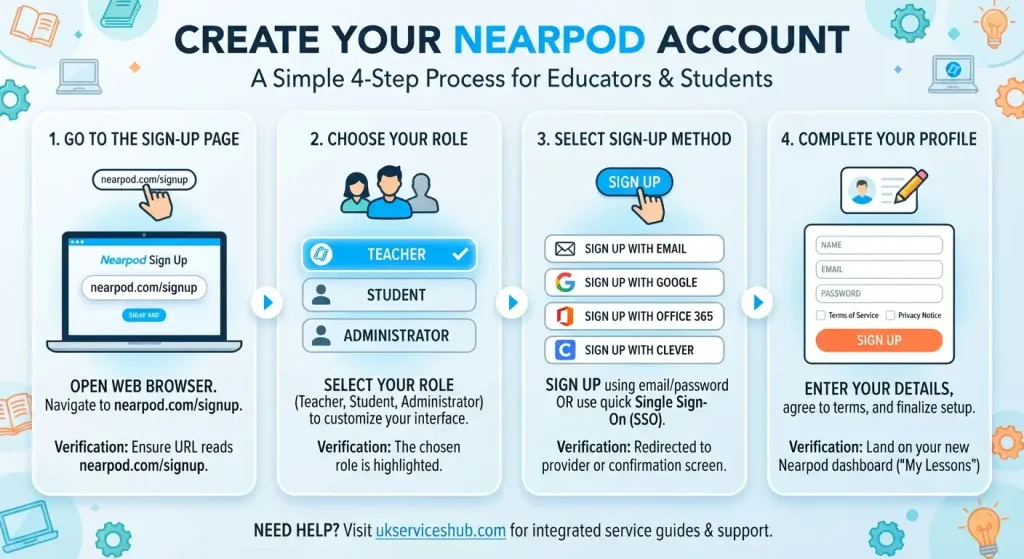
Nearpod account setup guide in 4 steps for educators and students

Setting up your near pod login is the first step for teachers and optional for students.

Step-by-Step Account Creation
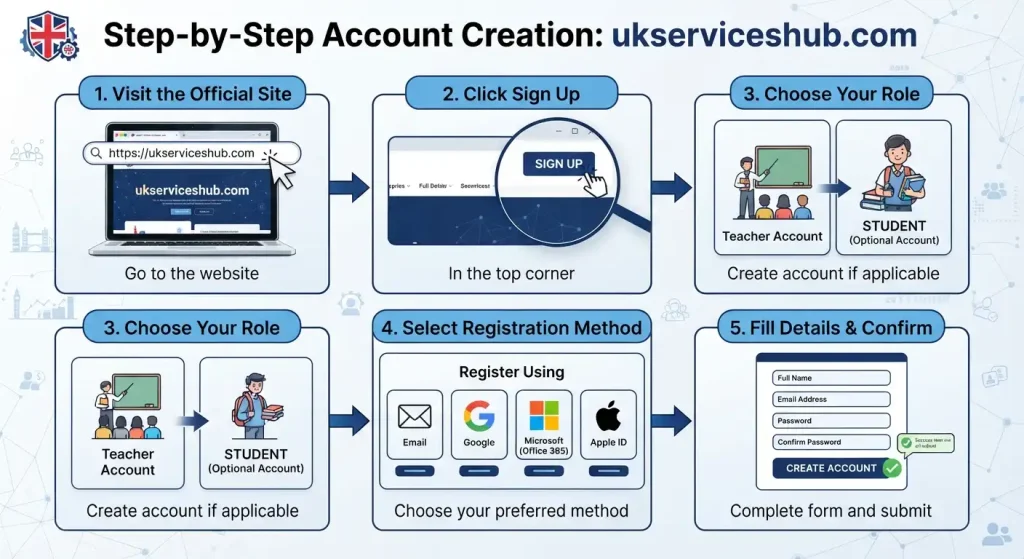
A visual step-by-step infographic guide for creating a teacher or student account on ukserviceshub.com, detailing the registration process from visiting the website to final confirmation.
  • Visit the official site:
  • Click Sign Up in the top corner
  • Choose your role:
  • Teacher
  • Student (optional account)
  • Select how you want to register:
  • Email
  • Google
  • Microsoft (Office 365)
  • Apple ID
  • Fill in your details and confirm

Once done, your near pod login credentials will give you access to the dashboard.

Important Note for Students
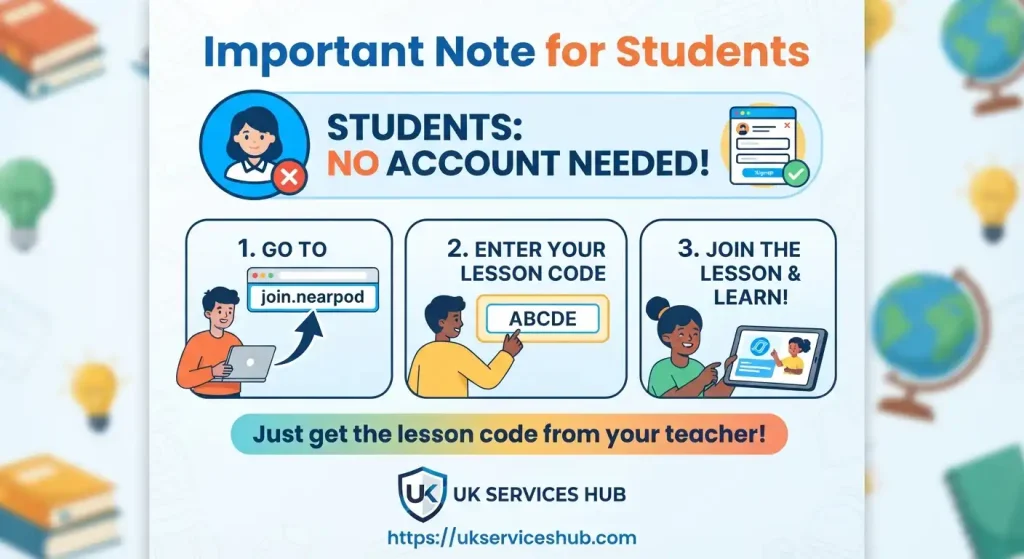
Important note for students joining Nearpod without an account using join.nearpod and a lesson code, published on UK Services Hub.

Students usually do not need an account.

Instead, they can directly use:

  • join.nearpod

All they need is a lesson code from their teacher.

Teacher vs Student Access (Understanding Roles)

Near pod works differently depending on who is using it.

Teacher Access

Teachers get full control over the platform:

  • Create and edit lessons
  • Use ready-made lesson libraries
  • Track student progress live
  • Generate reports after sessions

A teacher always needs a near pod login to manage content.

Student Access

Students use a much simpler system:

  • No account required in most cases
  • Join using a 5-letter code
  • Access lessons through join nearpod
  • Follow teacher-controlled slides

This makes near pod join fast and accessible even for beginners.

How to Join a Lesson (Student Guide)

Joining a session is one of the most searched actions, and it’s extremely simple.

Quick Join Steps

  • Open your browser
  • Go to:
  • Enter the 5-letter code
  • Type your name
  • Click Join Lesson

That’s it. You are now inside the session.

Alternative Method

Students can also:

  • Visit the main site
  • Click Join a Lesson
  • Enter the code

Both methods lead to the same result.

Key Tip for Smooth Joining

  • Always double-check the code
  • Use updated browsers (Chrome, Edge, Safari)
  • Avoid refreshing during live sessions

These small steps prevent most issues with near pod join.

How Near pod Works in Real Classrooms

The platform is designed to keep learning interactive and controlled.

Two Main Teaching Modes

1. Live Participation Mode

  • Teacher controls slides
  • Students follow in real time
  • Ideal for classrooms and live sessions

2. Student-Paced Mode

  • Students move at their own speed
  • Teacher shares a code or link
  • Perfect for homework and revision

Both modes rely on the same entry system: join.near pod

Why Schools Prefer Near pod

  • Easy student access via near pod join
  • No complicated setup for learners
  • Real-time engagement tools
  • Works on mobile, tablet, and desktop

It bridges the gap between traditional teaching and digital learning.

What’s Coming Next

In the next part, you’ll learn:

  • Classroom tools (quizzes, draw tools, collaboration)
  • Detailed near pod login process in bullet points
  • Troubleshooting common errors
  • Advanced usage tips for teachers

Classroom Features That Make Near pod Powerful

What makes near pod stand out is not just lesson delivery—but interaction. Teachers can turn simple slides into engaging activities that keep students involved from start to finish.

Interactive Tools You’ll Use Most

1. Time to Climb (Gamified Quiz)
A fun quiz where students compete by answering questions correctly. It keeps energy high and encourages participation.

2. Draw It Tool
Students can:

  • Solve maths problems
  • Highlight text
  • Label diagrams
  • Sketch ideas

This makes near pod join sessions more practical and hands-on.

3. Collaborate Board
Think of it as a shared digital board where students:

  • Post ideas
  • Share opinions
  • Upload images

It’s widely used in group discussions.

4. Open-Ended Questions & Quizzes
Teachers can instantly check understanding during a session. Responses appear in real time.

Near pod Login (Step-by-Step in Points)

For teachers and users who need an account, here is a clean and simple near pod login process:

  • Click on Login
  • Enter your registered email
  • Type your password
  • Click Sign In

Alternative Login Options

You can also log in using:

  • Google account
  • Microsoft Office 365
  • Apple ID

This is called Single Sign-On (SSO) and makes near pod login faster and more secure.

When Do Students Need Login?

Most of the time, students don’t need near pod login.

They simply:

  • Open join.near pod
  • Enter the code
  • Start learning

However, login may be required if:

  • The school enforces account-based access
  • Progress tracking is needed
  • Assignments are graded

Running a Lesson as a Teacher

Once logged in, teachers can start lessons easily.

Basic Teaching Workflow

  • Login to your account
  • Choose a lesson (create or select from library)
  • Click Launch
  • Select mode:
  • Live Participation
  • Student-Paced
  • Share the code with students

Students then use near pod join or join.near pod to enter.

Best Practices for Classroom Use

To get the most out of near pod, follow these simple strategies:

  • Keep lessons interactive every 3–5 slides
  • Use quizzes to check understanding
  • Allow time for student responses
  • Mix activities (quiz + drawing + discussion)

This approach improves engagement and reduces passive learning.

Common Mistakes to Avoid

Even though near pod is simple, small mistakes can cause issues:

  • Entering wrong join code during near pod join
  • Using outdated browsers
  • Not checking internet connection
  • Logging in with the wrong account

Fixing these early avoids frustration.

Performance Tips for Smooth Experience

  • Use Google Chrome for best compatibility
  • Avoid opening too many tabs
  • Keep internet stable
  • Refresh page only when needed

These tips help prevent lag during join near pod sessions.

Quick Comparison: Student vs Teacher Actions

FeatureTeacher RoleStudent Role
AccessRequires near pod loginUses join.near pod
Lesson ControlFull controlNo control
ParticipationMonitors activityResponds to tasks
SetupCreates lessonsJoins with code

What You’ll Learn Next

In the final part, we will cover:

  • Troubleshooting errors step-by-step
  • Fixing nearpod login issues
  • Solving join near pod problems
  • FAQs and expert tips

Troubleshooting Near pod Issues (Quick Fix Guide)

Even though near pod is reliable, users sometimes face small technical issues. Here’s how to fix the most common ones.

1. Invalid Join Code Error

Problem:
You try near pod join, but it shows Invalid Code.

Why it happens:

  • Code entered incorrectly
  • Session expired
  • Teacher ended the lesson

Solution:

  • Recheck the 5-letter code
  • Ask your teacher for a new code
  • Make sure you’re using the correct page:

2. Near pod Not Loading or Freezing

Problem:
Lesson doesn’t load properly after using join near pod.

Possible causes:

  • Slow internet
  • Browser issues
  • Too many open tabs

Fix steps:

  • Refresh the page
  • Switch to a stable internet connection
  • Use updated browser (Chrome recommended)

3. Audio or Video Not Working

Problem:
Media doesn’t play during lessons.

Common reasons:

  • Browser blocked autoplay
  • Sound muted
  • Extensions interfering

How to fix:

  • Enable sound permissions
  • Disable ad blockers for nearpod
  • Try another browser

4. Near pod Login Issues

Problem:
Unable to access your account via near pod login.

Fix checklist:

  • Visit:
  • Check email and password carefully
  • Try Forgot Password option
  • Use correct login method (Google, Microsoft, etc.)
  • Log out and log in again

5. Wrong Account Showing (Free vs School Access)

Problem:
You logged in but don’t see your school features.

Reason:

  • Logged in with personal email instead of school account

Solution:

  • Log out completely
  • Re-login using school email via near pod login
  • Use SSO (Google/Microsoft school account)

Expert Tips for Better Near pod Experience

Using nearpod effectively is not just about logging in or joining—it’s about using it smartly.

For Students

  • Always join early using join.near pod
  • Keep your device charged
  • Stay active during quizzes and activities

For Teachers

  • Mix content types (quiz + discussion + drawing)
  • Keep sessions interactive
  • Monitor student responses live
  • Use reports after class for evaluation

Frequently Asked Questions (FAQs)

Students use nearpod as part of their regular classroom activities to stay engaged and participate actively. Instead of just watching lessons, they interact through quizzes, polls, and drawing tools.

Typically, students:

  • Open join.nearpod or use nearpod join
  • Enter a lesson code shared by the teacher
  • Follow slides in real time or at their own pace

This makes daily learning more interactive, especially in digital or hybrid classrooms.

Nearpod was founded in 2012, which means it has been helping educators for over a decade. Over the years, it has grown into a widely used platform in schools across the world, supporting both in-person and online learning.

No, students usually do not need an account.

They can easily access lessons by:

  • Visiting join.nearpod
  • Entering a lesson code
  • Typing their name

However, in some schools, a nearpod login may be required for tracking progress or assignments.

Using nearpod offers several advantages for both teachers and students:

  • Interactive lessons instead of passive slides
  • Real-time feedback and assessments
  • Easy access through nearpod join
  • Works on all devices
  • Encourages participation and collaboration

These features make learning more engaging and effective.

While nearpod is useful, there are some limitations:

  • Requires stable internet connection
  • Limited features in the free version
  • Can be distracting if overused
  • Dependence on devices
  • Teachers need time to learn the platform

Understanding these helps in using nearpod login and classroom tools more effectively.

Technology, including tools like nearpod, offers many advantages:

  1. Improves communication
  2. Enhances learning experiences
  3. Saves time and effort
  4. Provides global access to information
  5. Supports innovation and creativity

Advantages:

  • Faster communication
  • Easy access to knowledge
  • Increased productivity
  • Better education tools like nearpod
  • Convenience in daily tasks

Disadvantages:

  • Screen addiction
  • Privacy concerns
  • Job automation risks
  • Distractions
  • Overdependence on devices

10 Advantages:

  • Quick information access
  • Online learning (e.g., nearpod join)
  • Global connectivity
  • Automation of tasks
  • Improved healthcare
  • Better communication
  • Digital storage
  • Entertainment options
  • Remote work opportunities
  • Innovation growth

10 Disadvantages:

  • Cybersecurity risks
  • Reduced physical activity
  • Social isolation
  • Privacy issues
  • Digital divide
  • High costs
  • Technical failures
  • Distraction from studies
  • Dependency
  • Data misuse

Advantages:

  • Fast calculations
  • Data storage
  • Easy communication
  • Online education (including nearpod)
  • Multitasking
  • Automation
  • Research access
  • Entertainment
  • Business efficiency
  • Accuracy

Disadvantages:

  • Security risks
  • Health issues (eye strain)
  • Dependency
  • Cost of maintenance
  • Virus attacks
  • Privacy concerns
  • Data loss
  • Job reduction in some sectors
  • Distraction
  • Requires electricity

Computers are powerful but not perfect:

  • Cannot think independently
  • Depend on user instructions
  • Require electricity
  • Vulnerable to viruses
  • Limited decision-making ability

Conclusion

Nearpod has transformed the way classrooms operate by making learning more interactive, flexible, and engaging for both teachers and students. Whether you are accessing lessons through nearpod join, managing your account via near pod login, or entering sessions using join.near pod, the platform is designed to be simple yet powerful.

Throughout this guide, you’ve seen how easy it is to set up an account, join lessons, and use classroom tools effectively without confusion or unnecessary steps. The real strength of near pod lies in its ability to combine teaching and participation in one place, allowing students to stay involved while teachers maintain full control of the learning process.

If used correctly, join near pod becomes more than just a way to enter a lesson—it becomes a gateway to active learning, better understanding, and improved classroom communication. By following the steps and tips shared above, you can avoid common issues and make the most of everything near pod has to offer.

Start with the basics, explore the features gradually, and you’ll quickly see why so many educators rely on nearpod login and interactive lessons to enhance modern education.

Read more..

OVO portal 

Coupa Supplier Portal

Mathsframe

Purple Mash Login


UK ETA

Similar Posts

Leave a Reply

Your email address will not be published. Required fields are marked *