UK Driving Theory Test 2026: How to Book, Prepare & Pass First Timear
UK Driving Theory Test 2026 is an essential step for learner drivers who want to get behind the wheel and progress towards their full UK driving licence. Whether you are booking your test for the first time or looking for effective ways to improve your score, knowing what to expect can make the process much easier.
The car test has two parts: multiple-choice questions and hazard perception. You must pass both parts to receive an overall pass. The current pass marks are 43 out of 50 for the multiple-choice section and 44 out of 75 for hazard perception.
In this complete UK Driving Test 2026 guide, you’ll learn how to book your test, what the test includes, how to prepare effectively, which revision methods can help, and practical tips for giving yourself the best chance of passing first time. We’ll also cover common mistakes learners make and how to approach the hazard perception section with confidence.Visit our home page for more information Click Here
What Does the UK Theory Test Involve?
The driving test checks whether you understand the knowledge and hazard-awareness skills needed before moving on to the practical driving test.
For car learners, the assessment is made up of two separate parts:
You must pass both parts. Passing the multiple-choice section but falling short in hazard perception still means you haven’t passed the test.
The multiple-choice questions can cover road rules, traffic signs, safe driving practices, different types of road users and situations where you need to identify potential risks.
The hazard perception section is more practical. You’ll watch moving road scenes and need to recognise developing hazards as they emerge. The aim isn’t simply to spot something unusual; you’re being tested on your ability to recognise a situation that may require you to take action.
Theory test at a glance
| Test detail | Current information |
|---|---|
| Car theory test fee | £23 |
| Multiple-choice pass mark | 43/50 |
| Hazard perception pass mark | 44/75 |
| Hazard perception clips | 14 |
| What you need to book | Provisional driving licence |
| Residence requirement | 185 days in England, Wales or Scotland during the previous 12 months |
| If you fail | Wait at least 3 working days before retaking |
The £23 fee applies to car and motorcycle tests. Lorry and bus categories have different fees and arrangements.
Are You Eligible to Take the Theory Test?
Before choosing a test date, make sure you meet the basic requirements.
For most people learning to drive a car, the minimum age to start learning is 17. You’ll also need the correct provisional driving licence, as GOV.UK requires this before you can book a car theory test.
The residence rule is particularly important if you’ve recently moved to Great Britain or are studying or living there from overseas. Normally, you must have lived in England, Wales or Scotland for at least 185 days within the 12 months before your test.
If you’re in Northern Ireland, don’t use the Great Britain booking process. Northern Ireland has its own theory-test service through nidirect.
Have these details ready before booking
The online booking process requires some basic information. It’s useful to have the following to hand:
If you need reasonable support or adjustments, mention your requirements when arranging the test so the booking service can take them into account.
Booking Your Theory Test: What to Do
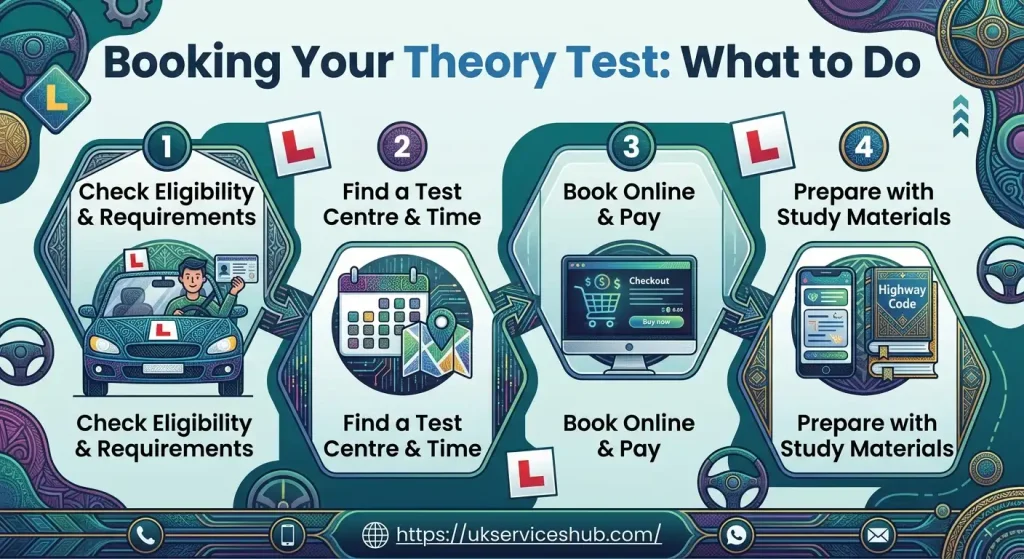
The easiest way to avoid unnecessary fees is to begin with the official GOV.UK service rather than a website advertising theory-test bookings through search engines.
Start with your provisional licence
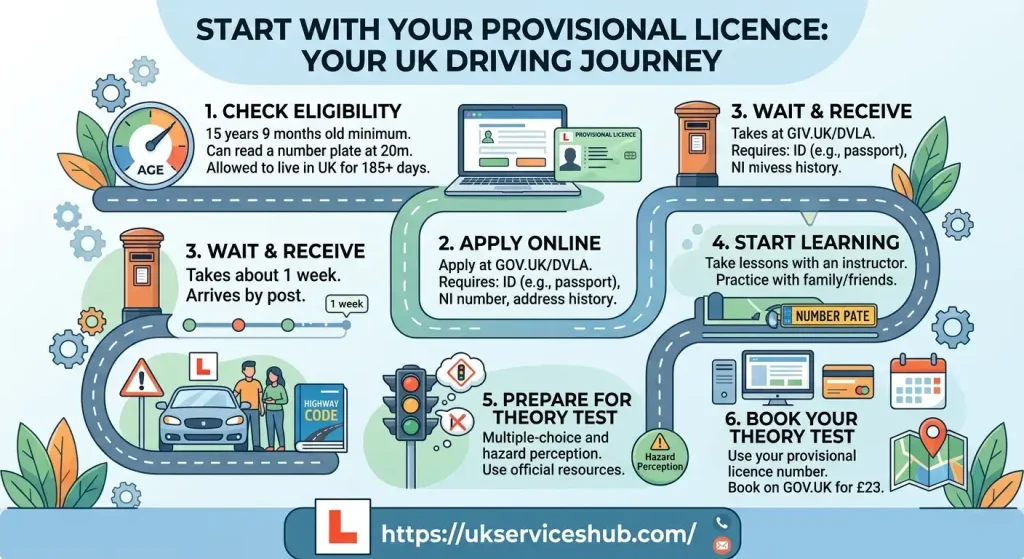
Check that your provisional driving licence is valid and that you have your licence number available. You’ll need these details as part of the booking process.
Use the official GOV.UK service

Go to the official government theory-test booking page and select “Start now”.
You’ll be asked for your driving licence number, email address and payment details. For a standard car test, the official fee is £23.
Be careful with third-party booking sites. Some websites appear official in search results but may charge additional fees for arranging a booking. Starting from GOV.UK is the safest way to make sure you’re using the government service.
Pick the correct test category

Choose the category that matches the vehicle you intend to drive, such as car or motorcycle. GOV.UK also provides testing arrangements for lorries, buses and coaches, although their fees and requirements are different.
Choose a test centre and date
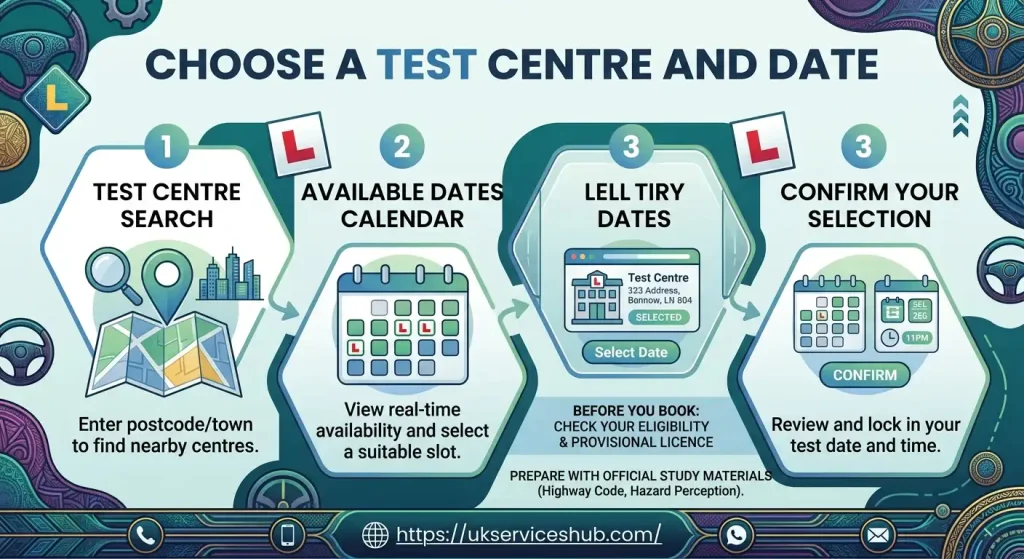
You’ll then be able to look for an available DVSA test centre and select an appointment.
Don’t feel pressured to take the earliest date you can find. Your test date should give you enough time to prepare properly. If you’re still regularly getting questions wrong in a mock driving theory test, having a little more revision time may be worthwhile.
Save your confirmation

Once you’ve booked, keep your confirmation details somewhere you can easily find them. You’ll need your appointment information if you later want to check or manage your booking.
A good rule: book when you’re reasonably prepared, not simply because the next available appointment happens to be convenient.
What to Revise Before You Book Your Test
Good preparation isn’t just about memorising theory questions. You need a solid understanding of driving rules as well as the ability to recognise hazards on the road.
The official GOV.UK theory-test guidance recommends using resources such as The Highway Code, driving lessons, vehicle-safety information, theory-test revision materials and official practice tools.
A good place to begin is The Highway Code. It covers the rules and guidance you’ll need to understand before sitting your test.
During your revision, make sure you’re familiar with areas such as:
A theory test app can also make revision easier, particularly if you only have a few minutes available at different points during the day. Regular practice can help you identify weak areas, but apps should be used alongside official guidance rather than as a substitute for learning the rules themselves.
GOV.UK also provides an official theory and hazard perception test app as part of its preparation resources.
Don’t Neglect the Hazard Perception Test
It’s common for learners to spend most of their revision time on multiple-choice questions. The hazard perception section can then receive much less attention.
That’s worth avoiding.
During hazard perception, you’ll watch 14 video clips showing normal road situations. Every clip contains at least one developing hazard, and one of the clips contains two.
A developing hazard is a situation that would require you to take some form of action, such as changing your speed or direction. For example, a parked car isn’t necessarily a developing hazard simply because it’s there. If it starts moving into your path, however, the situation has changed and it could become a developing hazard.
Each developing hazard can earn you up to 5 points. You’ll generally get the highest score when you identify the hazard as soon as it starts to develop.
The key skill is therefore not simply spotting objects or potential problems. You need to recognise when a situation is developing into something that may require you to act.
Avoid this common hazard-perception error
Don’t click repeatedly or follow a regular clicking pattern because you’re afraid of missing a hazard. GOV.UK warns that continuous or patterned clicking can lead to no score for that clip.
When using a mock driving theory test for revision, make sure it includes proper hazard-perception practice as well as multiple-choice questions. Getting comfortable with both parts of the assessment will give you a much better idea of what to expect on test day.
How the Two Parts of the Test Work
The car test is split into two assessments, and you need to meet the required score in both:
| Section | What you’re tested on | Pass mark |
|---|---|---|
| Multiple choice | Driving knowledge and road-safety questions | 43/50 |
| Hazard perception | Spotting developing hazards in video clips | 44/75 |
The official pass marks are 43 out of 50 for the multiple-choice section and 44 out of 75 for hazard perception.
So, don’t use your multiple-choice score alone to decide whether you’re ready. You might be getting most of the questions right in practice but still fail the overall test if you haven’t spent enough time working on hazard perception.
Getting Ready for the Multiple-Choice Questions
The first part of the test measures your knowledge of different driving topics. GOV.UK provides an official route for practising multiple-choice questions through its theory-test preparation service.
Rather than memorising a collection of correct answers, focus on understanding the rule behind each question.
Suppose you’re repeatedly getting questions about road positioning. Instead of remembering which option was correct, look up the relevant information in The Highway Code and understand why that position is appropriate. That way, you’ll be better prepared if the real test presents the same rule in unfamiliar wording.
Try the Learn–Practise–Review–Repeat method
A simple four-step cycle can make your revision more effective:
Learn → Practise → Review → Repeat
This approach is usually more productive than rushing through hundreds of questions without taking time to understand your mistakes.
Getting More Value from a Mock Driving Theory Test
A mock driving test shouldn’t just be about achieving the highest possible score. Use it to find out which areas still need work.
It’s perfectly normal for your results to move up and down during your first few practice attempts. Instead of worrying about one particular score, look for repeated weaknesses.
Ask yourself:
Write down the topics you struggle with. Then make those areas the focus of your next revision session instead of repeatedly practising subjects you’ve already mastered.
The official GOV.UK theory-test service includes links to practice theory and the official theory and hazard perception test app.
Official theory-test preparation and practice: GOV.UK
Should You Use a Theory Test App?
A theory test app can be a convenient way to revise when you don’t have time for a full study session. A few minutes of practice on your phone can still be useful if you use that time well.
You might use an app to work on areas such as:
The important thing is not to rely on the app alone. Treat it as a revision tool rather than your complete source of driving knowledge.
GOV.UK links learners to an official theory and hazard perception test app through its car theory-test guidance.
A useful strategy is: use practice questions to discover what you don’t know, then go back to authoritative guidance to understand the rule properly.
Hazard Perception: Don’t Leave It Until the End
Hazard perception requires a different type of preparation from multiple-choice questions.
You’ll watch 14 video clips showing everyday driving situations. Each clip contains at least one developing hazard, while one clip contains two.
The key concept to understand is the developing hazard.
A developing hazard is a situation that would require you to take action, such as changing your speed or direction. A parked car, for instance, isn’t automatically a developing hazard if it remains stationary and doesn’t affect your driving. If the driver starts indicating and the vehicle begins moving into the road, the situation can develop into a hazard.
What kinds of situations should you watch for?
As each clip plays, look for changes in the road situation, including:
The aim isn’t to click every time you notice something on screen. Instead, concentrate on recognising when a situation starts to develop into a hazard that could require you to react.
Understanding the Hazard Perception Score
In the hazard perception section, each developing hazard is worth up to 5 points. To give yourself the best chance of scoring well, GOV.UK advises clicking when you see a hazard beginning to develop.
Timing matters.
If you react too late, you may miss out on points because the hazard has already developed. On the other hand, clicking continuously or following a repeated pattern can result in no score for that clip.
There’s no benefit in trying to find a trick or pattern that beats the scoring system. Concentrate on the road scene and click when you genuinely recognise a developing hazard.
A simple way to practise
When working through hazard-perception clips, put yourself in the driver’s seat and ask:
“What would make me change my speed or direction if I were driving here?”
This helps you focus on situations that are actually developing rather than clicking simply because you notice a parked vehicle, pedestrian or other object.
Creating a Revision Routine That Works
You don’t have to spend several hours revising every day. Short, regular sessions can make it easier to stay consistent and remember what you’ve learned.
For example, you could spread your preparation across a week like this:
| Session | Main focus |
|---|---|
| 1 | Read and study The Highway Code |
| 2 | Practise multiple-choice questions |
| 3 | Go through incorrect answers |
| 4 | Work on hazard-perception clips |
| 5 | Revise road signs and markings |
| 6 | Complete a mixed mock test |
| 7 | Concentrate on your weakest areas |
As your test date gets closer, it can be useful to include more complete practice tests so you’re comfortable working through both sections.
One thing to watch out for is relying too heavily on familiarity. If you’ve seen the same question repeatedly, you may remember the wording or answer without actually understanding the rule. Make sure your revision is building knowledge, not just recognition.
The Main Resources to Use
1. The Highway Code
The Highway Code should form the foundation of your theory-test preparation. It contains the rules and guidance that road users are expected to understand and follow.
Read The Highway Code on GOV.UK
2. GOV.UK revision and practice materials
GOV.UK has a dedicated theory-test revision and practice service for learners. Use it to support your preparation and become familiar with the type of material you’ll need to study.
GOV.UK theory-test revision and practice
3. Practice theory test
It’s also worth completing an official practice test before your real appointment. This gives you an opportunity to check your current level and identify areas that need more work.
Using official resources alongside your normal revision helps keep your preparation aligned with the actual government testing process rather than relying solely on third-party apps or websites.
Getting Ready for Test Day
Your preparation shouldn’t stop when you finish revising. Make sure you know what you’ll need when you arrive at the test centre.
Your photocard driving licence is especially important. If you have a driving licence without a photograph, different identification requirements may apply.
Before setting off, run through this checklist:
Test-day checklist
It’s also worth keeping your booking information somewhere easy to access. If you’ve misplaced your confirmation, GOV.UK provides a service that allows you to check your theory-test appointment details.
Check your theory-test appointment details on GOV.UK
Do You Need Additional Support?
If you have a reading difficulty, health condition or disability, you may be able to receive appropriate support when taking the theory test.
Don’t assume you’ll automatically have to complete the standard test without assistance. GOV.UK asks candidates to provide information about relevant needs when booking so that suitable arrangements can be considered.
This can be particularly important if English isn’t your first language or you have a condition that affects the way you read or process written information. Check the official requirements before your appointment rather than relying on information from unofficial sources.
What Happens Once You Pass?
You need to pass both sections of the test to receive an overall pass.
After passing, you’ll receive a letter at the test centre containing your theory-test pass certificate number. You’ll need this number when arranging and taking your practical driving test.
Your theory-test pass remains valid for two years. You must pass your practical driving test within that period. If you don’t, you’ll have to take and pass the test again.
It’s important to see the theory as one stage of the wider driving process. Passing it doesn’t give you a full driving licence; you still need to successfully complete the practical test.
GOV.UK also confirms that you must pass the test before you can book your car driving test.
What Happens If You Don’t Pass?
A failed theory test doesn’t mean you have to start your learning from scratch.
You’ll receive your result at the test centre, including information about where you didn’t achieve enough points. Use that feedback to identify what needs more attention before booking another attempt.
You cannot retake just the section you failed. A new attempt means taking the full test again.
There’s also a waiting period: GOV.UK requires you to wait at least 3 working days before taking the test again.
Rather than immediately repeating the same revision routine, use the result to change your approach. Spend more time on the topics or skills that caused difficulty, then reassess your progress with another practice test.
Final Preparation Checklist
Before you sit the real test, make sure you can confidently tick off the following:
The UK theory is easier to approach when you remember that you’re preparing for two different skills. The first is your knowledge of driving rules and road safety; the second is your ability to recognise hazards and respond to developing situations.
Once you know what to expect in the UK test, your revision should focus on applying the rules rather than trying to memorise every line of The Highway Code. The real goal is to understand the rules well enough to use them when a question presents you with a situation you’ve never seen before.
How to Use Your Final Week Wisely
The last few days before your test aren’t the time to completely overhaul your revision strategy. Instead, use your practice results to work out which areas still need attention.
A practical final-week plan could look like this:
7–5 days before
Go back through The Highway Code, paying particular attention to topics you’ve struggled with during practice.
4–3 days before
Work through mixed multiple-choice questions and spend some focused time practising hazard perception.
2 days before
Sit a complete mock driving theory test in conditions that are as close to the real assessment as possible. Once you’ve finished, go through your incorrect answers and work out why you made each mistake.
The day before
Keep things manageable. Review road signs, difficult subjects and hazard perception rather than attempting to learn the entire syllabus again.
Test day
Check your appointment details, make sure you have the required licence and allow plenty of time to reach the test centre.
Your final mock test isn’t just about getting a big score. Its real purpose is to show whether you’re performing reliably in both sections of the test.
Mistakes That Can Hurt Your Preparation
Even well-prepared learners can make avoidable mistakes. Here are some of the most common ones.
1. Booking Through an Unofficial Website
There’s little reason to pay extra for someone else to arrange your booking.
The official car theory costs £23 when booked through GOV.UK, while the government warns that unofficial booking websites generally charge more.
Use the official GOV.UK booking service.
If a website appears to add unnecessary fees or makes the booking process seem more complicated than expected, stop and check that you’re using the government service before entering your card details.
2. Ignoring Hazard Perception
Spending all your revision time on multiple-choice questions can leave you unprepared for the second half of the assessment.
Remember that you need 43/50 in multiple choice and 44/75 in hazard perception to pass both sections.
A theory app can make regular practice easier, but don’t use it solely for multiple-choice questions. Include hazard-perception clips in your revision as well.
3. Clicking Without a Clear Reason
Hazard perception isn’t about clicking as many times as possible.
You need to recognise when a situation becomes a developing hazard and respond appropriately. GOV.UK warns that continuous clicking or clicking in a pattern can result in no score for the clip.
Instead of trying to guess how the system works, think about what you’d do if you were genuinely behind the wheel:
Has something changed, and would that change make me alter my speed or direction?
That approach keeps your attention on the developing road situation rather than on trying to beat the scoring system.
4. Learning Answers Instead of Rules
Practice questions are useful, but repeatedly seeing the same question can give you a misleading sense of confidence.
You might remember the correct option without actually understanding why it’s correct. In the real test, the same driving principle could be presented through different wording or a different situation.
Whenever you make a mistake, find the relevant rule, understand it and then practise the concept again.
5. Turning Up Without the Right Licence
Your test-day documents deserve the same attention as your revision.
GOV.UK provides specific instructions about what you need to bring to the test centre, so check the official requirements before your appointment.
Don’t leave this until the last minute. Finding out on test morning that you’ve misplaced your required identification can create unnecessary stress and may affect your appointment.
Can You Move Your Theory Test Appointment?
Yes. You can change your theory-test appointment if you need to move it to another date or use a different test centre.
There is an important deadline, though. You normally need to provide at least 3 full working days’ notice if you want to change the appointment without having to pay the fee again. Monday to Saturday count as working days, while Sundays and public holidays don’t.
If you’re approaching your test date and your practice results suggest you’re not ready, changing the appointment may be a sensible option. Giving yourself additional preparation time can be preferable to taking the test too early and potentially paying for another attempt.
Change your theory appointment – GOV.UK
What If You Have to Cancel?
The same 3 full working days rule generally applies when cancelling your test.
If you cancel during the final three full working days, you will normally lose the fee. However, GOV.UK identifies some situations where a refund may still be available, including:
You may need to provide evidence depending on the circumstances.
Knowing these rules before booking is useful because unexpected problems can arise between the day you make your appointment and the day of the test.
What Happens After You Pass?
You’ll receive your result at the test centre once you’ve completed the assessment.
If you’ve passed, you’ll be given a letter containing your theory-test pass certificate number. Keep this information safe because you’ll need it when booking and taking your practical driving test.
The certificate number remains valid for two years. You must pass your practical driving test within that period. If you don’t, you’ll need to take and pass the test again.
Passing the theory test is therefore a major milestone, but it isn’t the same as obtaining your full driving licence. The practical test is still required.
What Happens If You Fail?
A failed attempt doesn’t mean you need to go back to the beginning.
Your result letter will show the areas where you didn’t score enough points. Use that information to work out exactly what needs more attention before you try again.
You also can’t retake only the section you failed. You’ll have to sit the full test again, and GOV.UK requires you to wait at least 3 working days before another attempt.
A useful way to approach the next attempt is:
Review the result → find your weak areas → revise the relevant topics → practise again → book another test.
The aim isn’t simply to repeat the same test. It’s to use the result to make your next round of preparation more focused.
Frequently Asked Questions About the UK Theory Test
Conclusion
Preparing for the UK Driving Theory Test 2026 becomes much easier when you understand the test format and revise the right topics. Start by booking your test through the official service, then study the Highway Code, practise multiple-choice questions, and regularly complete hazard perception tests.
Give yourself enough time to revise, focus on your weak areas, and use mock tests to build confidence before test day. With consistent preparation and a good understanding of road rules, signs, hazards, and safe driving practices, you can improve your chances of passing the UK driving theory test first time and move one step closer to your practical driving test.


.](https://ukserviceshub.com/wp-content/uploads/2026/09/Feature-image-768x429.webp)