The EverLearner: Login, Student Access, Courses & Assignments Guide 2026
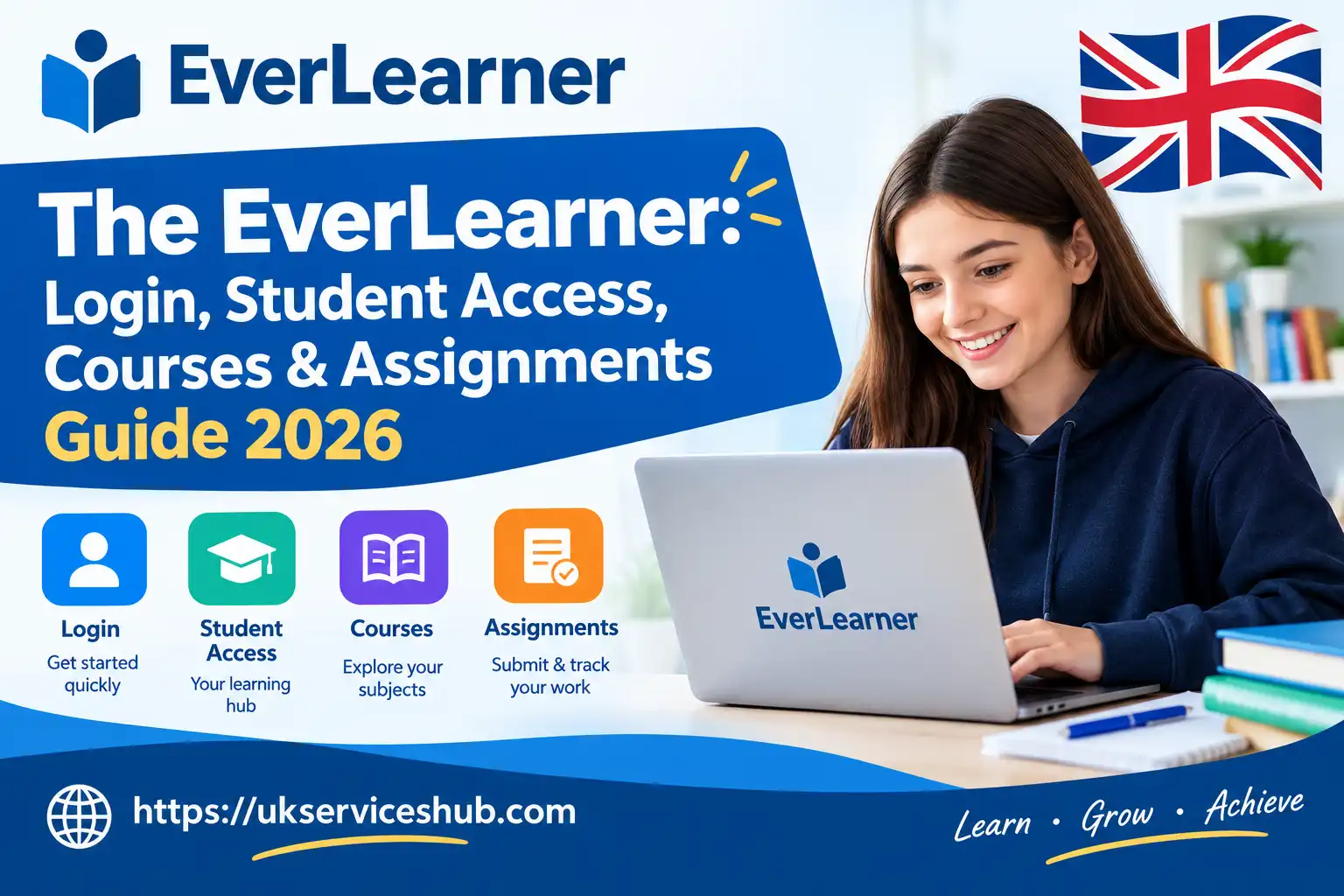
The EverLearner is an online learning platform designed to help students and teachers manage courses, learning activities, assignments, practice tasks and progress in one place. Whether you are trying to access your student account, find your courses, complete an assignment or understand how the platform works, knowing where to find each feature can make learning easier.
This guide explains how to use The EverLearner in 2026, including the EverLearner login, student access, courses, assignments and common account issues. You will also learn how to navigate the dashboard, access available learning materials and make better use of the platform’s study and assessment features.
If you are a student accessing The EverLearner through your school or college, this guide provides a straightforward overview of the key features you may need for everyday learning.
What Is The EverLearner?
The EverLearner is an online learning platform designed to help students access educational courses, complete assignments, and track their learning progress. Students can log in to their accounts to view course materials, access lessons, submit assignments, and manage their learning activities in one place.
This guide explains how The EverLearner works, including how to log in, access student accounts, find courses, complete assignments, and make the most of the platform in 2026.
EverLearner login: step-by-step
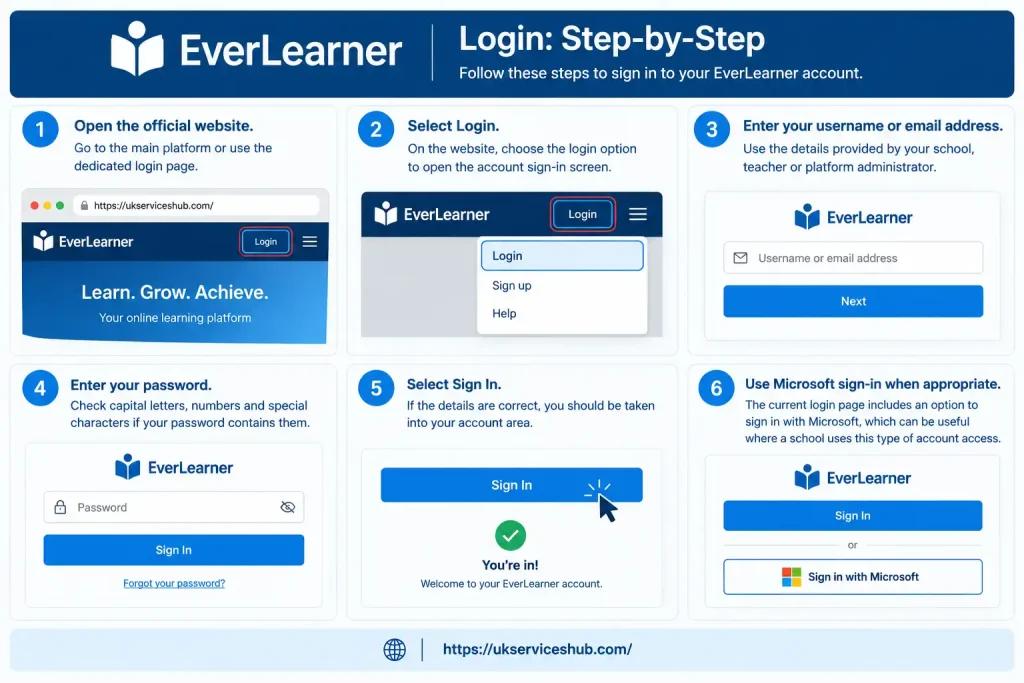
Use these steps when signing in:
Important: Don’t share your login details with another student. The platform’s terms state that accounts are intended for individual users and should not be shared between several people.
What Students See After Signing In
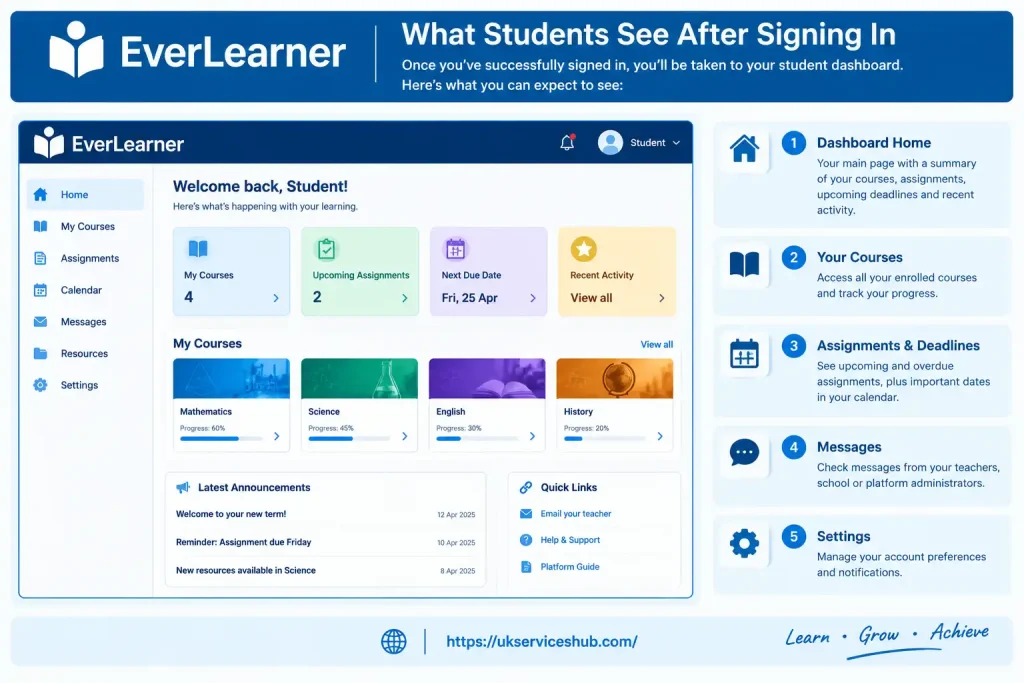
Once you have successfully accessed your account, your dashboard becomes the starting point for studying. The exact options available can depend on your role and the courses assigned to your account.
One useful point to understand is that having an account does not automatically mean every course will appear. The official help documentation explains that students need to belong to a group that has been enrolled on the relevant course.
From the dashboard, students can normally reach their available subjects and continue learning from the areas assigned to them.
A simple way to think about the student area
| Area | What it is used for |
|---|---|
| Dashboard | Starting point for available learning and activity |
| My Courses | Accessing courses assigned to your account |
| Lessons | Working through individual learning topics |
| Practice | Developing understanding without the pressure of a formal test |
| Test Yourself | Checking how well you can recall and apply knowledge |
| Assignments / Exams | Finding tasks and assessments set by your teacher |
The platform’s course structure can include chapters, topics, lessons and checkpoints. When a student opens a topic, available learning options can include starting a lesson, practising questions or testing their knowledge.
How to Find Your Courses
If you have completed your everlearner log in but cannot immediately see the subject you need, don’t assume that your account is broken.
First, check the Dashboard. The official course-access instructions say that subjects available to a student can appear there, with options such as Start Studying or Continue Studying. Another route is the My Courses link at the top of the screen.
Once you open a course, the content is organised into learning sections. This makes it easier to work through a subject in smaller stages instead of trying to study everything at once.
A practical study routine
A useful approach is:
Choose your course → open the relevant topic → study the lesson → practise → test yourself → review weak areas.
This is more useful than simply watching lessons from beginning to end because the platform separates learning, practice and testing into different activities.
The official site describes its Practice Mode as a lower-pressure learning environment, while Test Mode is intended to check what students have learned and practised. Checkpoints can also provide end-of-unit assessment with diagnostic feedback.
What If Your Course Is Missing?
If you have completed the everlearn sign-in process but a course is unavailable, check the following before contacting support:
Course access is linked to group enrolment, so a missing course may be an account or group setup issue rather than a problem with your browser.
Quick takeaway
Getting into the platform is straightforward once you know which route to use. Start with the official website, sign in with the credentials supplied to you, then use the dashboard or My Courses area to locate your subjects.
If you searched for everlearner pe because you need access to a PE course, the same basic account process applies. The course you see, however, depends on what your school or organisation has assigned to your account.
Working Through Lessons, Practice and Assignments
Once you have reached your student area, the next stage is using the learning content effectively. The platform separates study activities from testing, so students can build their understanding before checking their performance.
This section explains how to move from a lesson into practice, use testing features and deal with assigned work without repeating the same task unnecessarily.
How Course Content Is Organised
A course can be divided into several levels, making a large subject easier to manage. The official help centre describes a structure that can include chapters, topics, lessons and checkpoints. This means you can usually work through a subject in smaller units rather than opening an entire course at once.
A typical learning sequence looks like this:
Course → Chapter → Topic → Lesson → Practice → Test
Not every course will necessarily contain identical activities, so the options available to you can depend on the course and the way your teacher has set it up.
Start with the lesson
When you select a topic, begin with the available learning material. Pay attention to key definitions, examples and explanations instead of treating the video or lesson as something to watch passively.
If you are revising for an examination, make a short note of areas you could not explain confidently. Those topics can then become your focus during the practice stage.
Practice Mode and Test Mode
One useful distinction is between Practice Mode and Test Mode.
Practice is designed to give students an opportunity to develop their understanding without treating every answer as a formal assessment. The official platform describes Practice Mode as a lower-pressure environment for learning and development. Test Mode, by comparison, is intended to check knowledge after students have had an opportunity to learn and practise.
That difference matters when planning revision.
A sensible study cycle
This approach makes the platform more useful as a revision tool because a poor result becomes feedback rather than simply a mark.
Understanding Checkpoints
Some courses include checkpoints at the end of a unit. These can be used to assess understanding after students have worked through the associated learning material.
The official help information explains that checkpoints can provide diagnostic feedback. In practical terms, that means the result can help show which parts of a topic may need further revision rather than simply telling you whether you passed or failed.
If a checkpoint highlights a weak area, return to the corresponding topic and revise it before continuing.
Study tip: Don’t judge your progress from one score alone. Look for patterns in the questions you get wrong. Repeated mistakes often point towards a particular concept that needs more practice.
Managing Assigned Work
Assignments are different from ordinary revision activities because they may have been specifically selected by your teacher or school.
When an assignment is available, open the relevant task and read the instructions before beginning. Check whether the activity has a deadline, a required completion method or any special instructions.
Depending on how your school has configured the platform, assigned work may involve videos, questions, tests or other learning activities.
Before starting an assignment
Use this quick checklist:
Taking a minute to check these details can prevent avoidable mistakes.
Completing an Assignment Without Losing Your Place
If an assignment contains several activities, work through them in the order provided unless your teacher has given different instructions.
Avoid rushing simply because an activity looks familiar. Assigned work is often intended to check whether you can apply knowledge independently, so read each question before selecting an answer.
For video-based activities, concentrate on the required material. For question-based tasks, consider why an answer is correct rather than relying only on recognition.
If the platform allows you to leave and return to an activity, make a note of where you stopped so that you can continue efficiently.
What Happens After an Assignment?
The exact feedback process depends on the type of activity and how the teacher has configured the course.
Some activities can provide immediate information about performance, while other work may require teacher review. For that reason, students should not assume that every submitted task will produce an instant final grade.
If you can see feedback, use it as a revision tool. A wrong answer is particularly useful when you understand the reason behind the mistake and know which lesson or topic can help you correct it.
Feedback can help you identify:
This makes assessment part of the learning process rather than something that only happens at the end.
Finding the Right Course Quickly
Students with several subjects may find that locating a particular lesson becomes harder as their course list grows.
A useful habit is to organise your study around the topic you actually need rather than opening courses randomly. If you are preparing for an upcoming assessment, start with the subject, then narrow your focus to the relevant chapter or topic.
For example:
Subject → Unit → Topic → Lesson → Practice
This reduces unnecessary browsing and helps you spend more time studying.
If a course you expect to see is absent, remember that course availability is connected with your assigned group. The official help centre specifically notes that students need to belong to a group enrolled on the relevant course.
Using The Platform for PE Revision
Students searching for everlearner pe are often looking for Physical Education learning resources. The platform’s official website lists Physical Education among its educational resources.
For PE revision, the same general workflow can be applied:
Study → Practise → Test → Review → Repeat where necessary
Instead of repeatedly watching the same lesson, use practice questions to discover which parts of the topic you genuinely remember.
For example, if you understand the definition of a concept but struggle to apply it to an exam-style question, the problem may not be basic recall. You may need more practice applying the idea to a specific situation.
That distinction can make revision more targeted.
When an Activity Does Not Work Properly
Technical problems can interrupt an otherwise productive study session. Before assuming there is a problem with your account, try a few basic checks.
If a lesson or video will not load
If the problem affects only one lesson, make a note of the course, topic and activity name. That information can make it easier for your school or support team to identify the issue.
If an assignment does not appear
First confirm that you are signed into the account your school expects you to use. Then check the relevant course and dashboard areas.
If another student in the same class can see the task but you cannot, speak to your teacher or school administrator. The issue may relate to how your student account has been assigned to a group.
A Better Way to Use Online Revision
The platform is most useful when students treat it as an active learning environment rather than simply a video library.
A stronger routine is to ask yourself three questions:
What do I understand?
Identify the information you can explain without looking at your notes.
What can I apply?
Check whether you can use the knowledge in questions or examples.
What am I still getting wrong?
Return to those areas instead of spending all your time revising topics you already know.
This method also helps reduce wasted revision time. You can move through familiar material more quickly while giving extra attention to weaker areas.
Key Points From This Section
The main things to remember are:
With these basics understood, you can use the student area more confidently and keep your revision organised.
Password Help, Account Problems and Student Support
Even when the learning platform itself is straightforward to use, account problems can interrupt your study time. A forgotten password, an unavailable course or an assignment that does not appear can all have different causes.
The best approach is to identify the problem first and then use the appropriate support route rather than repeatedly trying the same login details.
Forgot Your Password? Follow These Steps
The current official sign-in page includes a Forgot password? option below the password field.
Password reset checklist
If your school manages student accounts, the exact recovery process can depend on how your account was created. The official Help Centre includes password-reset guidance as part of its general support resources.
What If You Cannot Find Your Login Details?
Students normally receive account information through their school or organisation. The platform’s terms state that student accounts are associated with the student’s school email address and that access to courses and modules is allocated by the teacher or account administrator.
If you never received your details, check:
The official Help Centre also lists a specific FAQ covering situations where students have not received their new password email.
Don’t create a second account unnecessarily
If your school has already created an account for you, creating another profile may make it harder for your teacher to connect your work with the correct student record.
Ask your teacher or school administrator to confirm which account you should use before registering again.
Microsoft Sign-In and School Accounts
The current login screen includes Sign in with Microsoft alongside the standard username/email and password fields.
Whether this option is suitable for you depends on your school’s account setup.
The official platform documentation also explains that schools using Microsoft or Google environments may use single sign-on.
If your teacher has told you to use school single sign-on, follow that route instead of repeatedly entering a separate password.
When a Course or Lesson Is Locked
A locked lesson does not necessarily mean that your browser or account is broken.
Access to courses is connected with group membership and course allocation. The official course-access guide says that students must be logged in and part of a group enrolled on the course they want to study.
If a lesson or course is unavailable:
This is particularly relevant when students have recently changed classes, subjects or academic year groups.
Assignment or Exam Problems
For exam assignments, the platform has a specific student workflow.
The official ExamSimulator student guide explains that students can receive an email and platform notification when a teacher sets an exam assignment. Practice and assessed exams can then be accessed through Assignments/Exams → Exams → Next Exams → Open now.
There can be different types of exams, including:
The way you complete an exam therefore depends on which type your teacher has assigned.
After an exam has been marked
Once marking has been completed and released, students can review the feedback through the assignment.
For practice and assessed exams, the official guide says students can use See Question Level Analysis to review performance question by question. The Knowledge and Skills sections can also point students towards lessons, practice quizzes and tests for areas that need more work.
That creates a useful revision loop:
Complete assessment → review feedback → identify weak areas → revisit learning material → practise again.
General Technical Troubleshooting
If the platform is not behaving as expected, try the basics before assuming your account needs technical intervention.
Login page will not load
Check your internet connection and refresh the page. If the issue continues, try another browser or device where possible.
Password appears to be wrong
Make sure you are entering the correct account details and check whether your browser has automatically filled an old password.
If you still cannot sign in, use the official password-recovery option rather than repeatedly guessing.
Course does not appear
Check Dashboard and My Courses, then ask your teacher whether your account belongs to the correct group. Course access depends on the relevant group and course assignment.
Email notification has not arrived
Check spam or junk folders. School email systems can sometimes filter automated messages, and the official setup guidance specifically recommends checking that messages from [email protected] are not being blocked.
Video or lesson behaves unexpectedly
Refresh the page and try again. If the issue remains, record the name of the course, topic and lesson so that your teacher or support team has enough information to investigate it.
Where to Get Official Help
The official The EverLearner Help Centre is the best starting point for platform-specific questions. It contains separate resources for learners, teachers, ExamSimulator users and general support.
You can use:
The Help Centre includes guidance on password resets, browser issues, assignments, locked lessons and other common problems.
For broader account or subscription questions, the official website also provides support and contact options. The platform’s current Teacher Hub directs users towards its support team when the knowledge base does not answer their question.
Frequently Asked Questions
Conclusion
The EverLearner makes it easier for students to access online courses, manage assignments, and keep track of their learning activities in one place. By using the The EverLearner login, students can access their accounts, explore available courses, view learning materials, and complete assignments efficiently.
Whether you are a new student learning how to access The EverLearner student portal or an existing user looking for a convenient way to manage courses and assignments, understanding the platform’s main features can help you get the most from your online learning experience. With the right login details and regular use of the available resources, students can stay organized and engaged throughout their courses.
Read more..

.](https://ukserviceshub.com/wp-content/uploads/2026/09/Feature-image-768x429.webp)