Physics & Maths Tutor: Online Tuition Complete Guide 2026

Finding reliable academic support can be difficult when a student is struggling with Maths or Physics. You may be looking for a tutor who understands the UK curriculum, knows how GCSE and A-Level exams work, and can explain difficult topics without making the subject feel even more complicated.
A maths and physics tutor can provide that one-to-one support, but tutoring is only one part of successful revision. Students also need good study resources, regular practice, feedback and a clear understanding of where they are losing marks.
This is where Physics & Maths Tutor (PMT) can be useful. The maths and physics tutor website brings together revision materials, topic questions, past papers, notes, solution resources and online tuition in one education-focused platform. It covers not only Maths and Physics but also subjects such as Biology and Chemistry.
What Is Physics & Maths Tutor?
Physics & Maths Tutor, commonly known as PMT, is an online revision and education platform designed to support students with GCSE, IGCSE and A-Level study.
The maths and physics tutor website is particularly useful for students who want to combine independent revision with personalised academic help. Instead of depending entirely on a tutor, a learner can use PMT’s resources to practise a topic, identify mistakes and then discuss difficult questions during a lesson.
The platform includes resources such as:
This makes PMT more than a place to find tuition. It can become part of a student’s wider revision routine.
Do You Need a Maths and Physics Tutor?
Not every student needs private tutoring.
Some learners can make good progress by using school lessons, revision guides, topic questions and past papers independently. Others understand the material in class but become stuck when they have to apply it to unfamiliar examination questions.
A tutor can be especially useful when a student:
The key question is not simply, “Do I need a tutor?”
A better question is:
“What problem do I need the tutor to solve?”
If the answer is clear, it becomes much easier to choose the right type of support.
How to Find the Right Maths and Physics Tutor
Choosing a maths and physics tutor should start with the student’s needs rather than the tutor’s qualifications alone.
A tutor who is excellent for an A-Level student may not be the best choice for a GCSE learner who needs help rebuilding basic algebra. Likewise, someone who teaches GCSE Maths successfully may not have the specialist knowledge required for advanced A-Level Physics.
Match the tutor to the student’s level
Before booking tuition, establish exactly what level of support is required.
This could include:
The supplied PMT information also highlights the importance of matching tuition to the learner’s academic requirements and examination level.
Check exam-board knowledge
A student’s exam board matters.
AQA, Edexcel and OCR can have differences in specifications, question styles and assessment requirements. A tutor familiar with the relevant specification can make lessons more focused because practice can be linked to the type of questions the student is expected to answer.
For GCSE and A-Level students, ask whether the tutor is comfortable working with the learner’s specific course.
Look beyond qualifications
Qualifications are useful, but they do not automatically make someone a great teacher.
A strong tutor should also be able to:
PMT states that its tutors are hand-selected and personally interviewed, with qualifications, expertise and teaching ability considered as part of the process.
What Makes Good Maths and Physics Tutoring?
The best tutoring should feel like a conversation rather than a lecture.
Imagine a student is struggling with a Physics calculation. Simply showing the correct equation may not solve the real problem.
The tutor should find out whether the student is struggling because they:
That diagnosis changes the lesson completely.
The same applies to Maths. If a student keeps getting algebra questions wrong, the issue might not be algebra itself. They could be struggling with fractions, signs, rearranging equations or interpreting the question.
Good tutoring identifies the underlying issue instead of repeatedly treating the symptom.
Maths and Physics Tutor Online: What to Expect
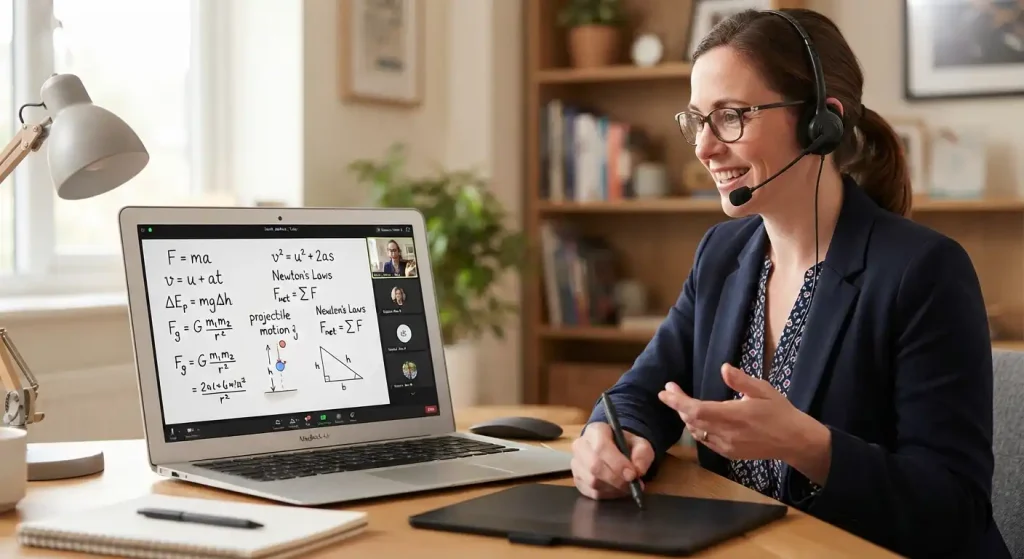
Online tuition can be a convenient option for students who want specialist support without travelling to a tutor’s location.
PMT’s tuition service provides one-to-one online tuition with subject-specialist tutors, allowing lessons to focus on academic support and examination preparation.
A typical online session might involve:
Review → Explain → Practise → Correct → Repeat
For example, a student could send difficult questions before the session. The tutor can then use the lesson to explain the underlying concept, work through an example and allow the student to attempt a similar problem.
This makes maths and physics tutor online support particularly useful when the learner already knows which areas are causing difficulty.
Before the lesson
Don’t arrive at every lesson saying, “I don’t know what to revise.”
Instead:
During the lesson

The student should actively participate.
Ask questions. Explain your reasoning. Tell the tutor where you became confused. Try problems yourself rather than watching the tutor solve everything.
After the lesson

Repeat the skill independently.
This is important because understanding something while a tutor is helping you is different from being able to solve it alone.
Using the Maths and Physics Tutor Website for Revision
One of the most useful ways to approach PMT is to combine tutoring with independent study.
The maths and physics tutor website provides resources that can help students prepare before a lesson and practise afterwards. The supplied information highlights revision notes, worksheets, topic questions and past papers as part of the platform’s resources.
A simple workflow is:
1. Choose one topic
Don’t begin with an entire subject.
Choose something specific, such as algebra, forces, electricity or differentiation.
2. Review the concept
Read through the relevant revision material and make sure you understand the basic idea.
3. Attempt questions
Use topic-based questions to test whether you can actually apply what you have learned.
4. Record mistakes
Don’t simply look at the correct answer and move on.
Ask why your answer was wrong.
5. Take difficult questions to your tutor
The questions you cannot solve are valuable lesson material.
6. Try similar questions afterwards
This is the step that checks whether the explanation actually helped.
Maths and Physics Tutor Past Papers: How to Use Them Properly
Past papers are extremely useful, but they should not always be the first revision tool you use.
If a student has not yet learned a topic, immediately attempting a complete paper can create dozens of mistakes without showing what needs fixing.
A better approach is to progress through different levels of practice.
| Revision stage | Main purpose |
|---|---|
| Topic questions | Find specific weaknesses |
| Mixed questions | Learn to select the correct method |
| Timed sections | Improve speed |
| Full past papers | Simulate examination conditions |
| Error review | Understand lost marks |
The maths and physics tutor past papers resources can therefore be most useful when combined with proper analysis rather than simply counting how many papers have been completed.
A student who completes five papers without reviewing mistakes may learn less than someone who completes two papers and carefully studies every error.
Maths and Physics Tutor Maths Resources
Maths requires more than memorising formulas.
A student needs to understand relationships between concepts and recognise which method is appropriate for a particular problem.
Depending on the level, a maths and physics tutor maths lesson may involve:
For GCSE learners, the priority may be strengthening core skills. At A-Level, the emphasis often moves towards multi-step reasoning and applying mathematical techniques to unfamiliar situations.
A useful tutoring question is:
“Why did you choose this method?”
If the student can explain the decision, they are developing understanding rather than simply copying a procedure.
Maths and Physics Tutor Physics Support
Physics presents a different challenge because students have to connect mathematical calculations with physical ideas.
A student may remember an equation but still struggle to decide when it should be used.
A maths and physics tutor physics session can therefore focus on both the theory and its application.
Students may need practice with:
For an unfamiliar question, encourage the student to ask:
What information have I been given?
What am I being asked to find?
Which physical principle connects these quantities?
Are my units correct?
Does my final answer make sense?
This thought process is often more valuable than memorising another list of formulas.
Can PMT Help With Biology and Chemistry?
Yes. Although the name strongly associates the platform with Physics and Maths, the PMT website also includes resources for subjects such as Biology and Chemistry.
This can be useful for students studying several STEM subjects at GCSE or A-Level.
The important distinction is that students should still choose support based on the individual subject. A tutor who specialises in Physics is not automatically the right person for advanced Chemistry or Biology.
When searching for maths and physics tutor biology or maths and physics tutor chemistry resources, use the subject-specific sections of the website rather than assuming that one tutoring approach works equally well for every subject.
How Much Does a Maths and Physics Tutor Cost?
Tutoring prices can vary according to experience, subject level, lesson format and the type of support required.
According to the supplied PMT information, its tuition service lists prices starting from £20 per hour. Current pricing should always be checked on the official PMT tuition page because individual tutor availability and rates can change.
The broader figures in the supplied material suggest that UK tutoring can range from around £20 per hour for undergraduate or peer-level tutors to considerably higher rates for experienced teachers and specialist educators. These should be viewed as general market examples rather than fixed PMT prices.
When comparing costs, consider the value of the lesson.
A cheaper tutor who does not understand the student’s needs may provide less value than a more experienced tutor who identifies the problem quickly and teaches efficiently.
Maths and Physics Tutor Login: What Students Should Know
One important point for anyone searching maths and physics tutor login is that PMT is not simply a conventional student login portal where all users need an account to access every revision resource.
The PMT website contains publicly available educational resources, while its tuition service is a separate part of the platform.
If you are trying to access a specific account, tuition service or student area, the safest approach is to start from the official website rather than using an unfamiliar third-party login page.
This is especially important for students and parents because search results can sometimes contain unofficial pages that use similar wording.
Supporting a Student Who Is Falling Behind
When a student is struggling, adding more and more worksheets is not always the answer.
First find out what is causing the difficulty.
A simple system can help:
| Status | Student’s situation | What to do |
|---|---|---|
| Green | Can answer independently | Keep practising |
| Amber | Understands but makes mistakes | Review and practise |
| Red | Cannot confidently begin | Prioritise with tutoring |
For example, if a student is repeatedly making Physics calculation errors, the tutor should investigate whether the issue is Physics knowledge, algebra, units or question interpretation.
Once the actual weakness has been identified, lessons become much more productive.
Don’t Let the Tutor Do Everything
This is one of the biggest mistakes students can make.
If the tutor solves every difficult question, the student may feel that the topic is easy during the lesson. The real test comes later when they are alone.
A better progression is:
Tutor demonstrates → student follows → student receives prompts → student solves independently.
By the end of the process, the tutor should be doing less, not more.
That is a sign that the student is becoming more confident.
A-Level Maths and Physics: When Specialist Tuition Helps
A-Level work usually requires more independent reasoning than GCSE.
Students may know the basic theory but struggle when several ideas appear in one question. This is especially common in Maths and Physics, where a question can require several steps before reaching the final answer.
A specialist tutor can help students:
For A-Level students, the aim should gradually shift from “Can I follow this example?” to “Can I solve a new problem without help?”
That is the real test of understanding.
A Simple Weekly Study Routine
Tutoring works better when it is part of a regular routine.
A student could structure the week like this:
Monday: Review lessons and identify weak areas.
Tuesday: Complete topic questions.
Wednesday: Attend the online tutoring session.
Thursday: Repeat similar questions independently.
Friday: Review mistakes.
Weekend: Complete mixed or timed practice.
The exact days do not matter. Consistency does.
Even a short weekly routine can be more useful than leaving all revision until a few weeks before the examination.
Final Checklist Before Choosing a Tutor
Before committing to regular tutoring, ask:
If the answer to most of these questions is yes, the tutoring arrangement is more likely to be productive.
Frequently Asked Questions
Conclusion
The best maths and physics tutor is not necessarily the person with the longest list of qualifications or the highest hourly rate. The better choice is someone who understands the student’s level, identifies the real source of difficulty and knows how to turn that weakness into a practical learning plan.
PMT can support that process by combining tutoring with revision notes, topic questions, past papers and other study resources. This gives students the opportunity to prepare independently, use tutoring for personalised help and then return to practice after the lesson.
For GCSE students, the focus may be on building secure foundations and becoming comfortable with examination questions. For A-Level learners, the emphasis increasingly moves towards deeper reasoning, multi-step problems and applying knowledge to unfamiliar situations.
If you are considering maths and physics tutor online support, start by identifying exactly what the student needs help with. Then choose the appropriate level, check the tutor’s subject and exam-board experience, and use PMT’s revision resources to reinforce what is taught.
The goal is not simply to have more lessons.
The goal is to help the student reach the point where they can sit down with a difficult Maths or Physics question and think:
Read more..